Archive for the ‘Web/Internet’ Category

How the Web Picks my Movies for me

Tuesday, June 30th, 2009

Back in the day…

  • It was all Siskel & Ebert or the guy with the crazy hair + mustache
  • The papers told you how long a movie’s been in the theaters
  • You had more than a week to decide if you were going to see a movie or not before it disappeared to DVD
  • If you missed it in the theaters, it was virtually impossible to know when you’d get to see it at home on tape

Today, we have amazing collaborative filtering systems (if you like Blah, then you’ll probably like Blah Blah), we know the exact gross a movie has made (even the ones that made, on average, $237 per screen), and every other little detailed stat imaginable.  And with the exception of reporting the revenue/gross of a movie, I think we’re mostly for the better.  These days, it only takes a little bit of trust “in the system” to weed out the good movies from the dreck. And as a father of two with virtually no movie-going times, choosing wisely is key for me.

Example one: picking a movie in the theaters.

rt-terminator

I don’t even really think about the $10 (or more) to go see a movie as much the 2 hours of my life I’m about to commit to something.  So when a movie’s in the theaters, I check just one site – rottentomatoes (RT).  On RT I see an instant score, which is the aggregate of all reviewers.  Anything under 50% and I assume it’s not theater-worthy.  The truth is, I don’t put much stock into any given reviewer’s thoughts, but the power of RT is reminiscent of fivethirtyeight.com’s ability to pull together order out of chaos.  BUT, that doesn’t mean I’ll never see the movie…

Example two: watching something On Demand (or just DVRing something)

imdb-terminator

After a movie’s made the rounds, I tend to put a bit more stock into the community/viewership as opposed to reviewers.  Movies like Caddyshack, Shawshank Redemption, and others that I’ve liked did terribly with the critics, but that doesn’t mean they aren’t worth seeing.  This is where the Internet Movie Database (IMDB) comes into play for me.  Anything above 7 is definitely watchable, below 6 is not, and in between is a judgment call.  But I never, ever DVR something without checking IMDB first…

Example three: adding to the Netflix queue

netflix-queueVirtually everything in my Netflix queue came through the internal Netflix recommendations system.  It’s just plain awesome. I barely even look at the 5-star score, I have gotten so trusting of it.  Granted, I don’t take every recommendation, but I can browse the “Movies You’ll 8>” and just add and add away.

And there you have it.  Movie picks, courtesy of the Internet, no thought required.

Thoughts on… Dell Buying Palm, Facebook Vanity URLs, Building43, Project Natal, Content Consumption

Saturday, June 13th, 2009

Kinda enjoying the “wrapup” post concept.  I feel less pressure to blog, and take a bit more time to collect my thoughts (instead of jumping on board any given meme as it happens).  Would definitely like to know from my reader(s?) if this is harder content to consume than more frequent, shorter posts.

Dell Buying Palm

This rumor’s been floating for a while. At the Building43/TechCrunch party I was told it was a certainty, though the NY Times thinks it’ll never happen.  At this stage in the mobile game, I think Palm does need an acquisition if it wants to survive as a big player, either that or needs a drastic overhaul/downsizing until they think like a startup again (which really is the position they are in). Dell’s a decent suitor, though I’d doubt they’d really escalate the brand to the level it needs.  I’d rather see a merger with Motorola’s mobile group, as they have the true infrastructure needed to compete at the high stakes table, and could really use an injection of creativity and new technology (no more RAZRs guys).

Facebook URLs

This whole week Facebook did a replay of Oklahama in the late 1800s (including allowing “key journalists” in sooner than us lame users). The stats last night were impressive, though I’m still sitting here scratching my head on the whole thing a little.  I’m assuming FB plans to do some serious SEO work, enabling those who grabbed useful terms like “carpenter” (no, I don’t know that guy) to generate a little business out of them. That said, some useful terms like “sanfranciscosushi” are still up for grabs, so enterprising folks should put their creative hats on and get going.  I didn’t take my name yet (having a unique name makes that kinda easy) because I just don’t get the value to me personally.  Googling Jeremy Toeman always gets me, as does the first page or two for just Toeman.  Not to say I didn’t try a few names to see how they’d feel…

gefiltefish

nah… not quite right.

Building43

My friend Robert Scoble started working at Rackspace (the place where we host Legacy Locker, btw) a few months back, and he’s been dropping hints about this “Building43″ thing for a while now.  This week he formally unveiled it during the TechCrunch 4th birthday party down in Palo Alto.  First and foremost, thanks Robert and Mike for some amazingly good BBQ food – oh, and your contributions to the tech industry blah blah blah ;) . So Building43 is designed as a resource for entrepreneurs and big companies alike to participate and gain feedback and insight from the tech community at large.  It’s an ambitious goal, and I wish them a lot of luck.  My biggest advice to them is to really focus on the user experience, as right now I found the site a little confusing to navigate (despite my personal familiarity with all the technologies they are using, like FriendFeed).  If it’s tough for me to find things, I can’t imagine what it’s like for those new to it.

Project Natal

Microsoft introduced “Project Natal” at E3, and there’s a rumor circulating that instead of thinking of it as a new component to the Xbox 360, it might be its own console. I love the idea of using motion capture as a video game controller (or remote control or any other kind of interface), but I think that’s where my love ends. As an idea.  Here’s the issue – it’s not good enough if it’s 99% accurate. Why?  Because the 1 time in 100 that you shoot instead of duck, or block instead of jump, or whatever mistake it makes is going the about the last time you play seriously.  Fundamental to every good user interface is absolutely perfectly reliable controls, with proper feedback mechanisms to the user.  With a motion controller, the moment the game doesn’t do what you wanted it to do, it’s all over.  Trust is lost, and the “magic moment” is replaced by dislike, then eventually anger. I saw a tweet that I think encapsulated the issue perfectly: “Project Natal is headed to the uncanny valley.

Content Consumption

I recently realized I don’t read any blogs anymore.  I do a lot of searching.  I follow some folks on Twitter and/or FriendFeed.  But I almost never just go to sites like Engadget or TechCrunch nor friends of mine like Dave Zatz or Michael Gartenberg and just read.  And based on looking at the analytics for many of my clients’ web sites, I’m thinking I’m very much not alone.  There’s too much content, and just not enough ways to organize it.  If I were an enterprising lad, I’d be spending a lot of time figuring out how to help people deal with content overload in a very useful manner.  The right tool needs to combine all the potential sources a user wants, and give lots of ways to customize and filter it.  Google Reader isn’t enough, nor is FriendFeed, nor is Facebook.  I’ve got a hunch there’s a lot of opportunity for an excellent “get signal out of my noise” service, and it’s probably something people would pay for.

Have a great weekend everyone, I’m heading back to toil in the garden where I can be really productive.

How I’d Build a Search Engine

Thursday, June 11th, 2009

Over the past year, we’ve seen no fewer than three major attempts to compete with Google come to market, with mixed results.  Cuil’s disastrous launch last Summer all but killed their chances of success.  Wolfram is in murky waters trying to remain distinctly not a search engine. And Microsoft is presently trying to buy their way onto the scene with Bing. I think there’s little-to-no debate that we should not let our entire worldview and information dissemination be in the hands of a single company (a recent study showed over 70% US market share – that’s just plain dangerous).

But how does one out-Google Google?  I’ll start with the “don’t”s, the things that should be avoided.

  • Bigger ain’t better. Nobody, and I mean nobody, cares that your search index is 17.37835% deeper than Google’s.  Search is at worst a semi-solved problem, which means the average person looking for something online probably perceives Google will have it.
  • Don’t confuse simple with simplistic. If you didn’t know, Google’s design is as simplistic as it is because they didn’t really know HTML when they started!  For some reason, this has caused legions of lookalikes, despite plenty of better examples of usability design.
  • Overhype can be bad. It’s a tricky challenge, but to even play in this space it is essential to set, then meet or exceed expectations.  Wolfram is doing this fairly well, Cuil did it badly.
  • Don’t enable spam. If there’s one evil Google is blatantly doing, it’s enabling spam.  Spam blogs. Spam news sites. Spam landing pages. The sheer ability to create and profit from a hosted domain with nothing but uselessness is a horror Google has unleashed upon us, and is unfortunately financially motivated to continue to enable.  I believe this is the weakest chink in Google’s armor, and there’s at least some opportunity to someone promising “spam-free search results.”  Be the ball.

Now for the “what would I do” part…

  • Launch with a great vanity search. When I read peoples’ experiences with Cuil or Bing, they invariably mention the egosearch they did.  It’s a fairly safe bet that most people will search for their own names within their first few searches, and this experience should rock.  When I google myself, I find my blog, my linkedin profile, my Flickr page, and other things I’d expect to see.  The first day I Cuil’ed myself, I saw nothing, due to a technical error.  A very very costly technical error.  When I Bing myself, I see much of the “correct” results, but 2 entries for FriendFeed, 1 for Ether, and some other seeming obscurities – and I don’t want obscure first.  I genuinely believe a good vanity search experience is a make/break issue for a new search player.notjeremybing
  • Do more than search. Part of what makes Google such a great product is the way it encompasses everything from a calculator to a flight tracker to movie listings and more.  These extra features make it stickier, and make me as a user less likely to leave.  So you have to play a similar game and offer services well beyond search.  Personally, I’d do this through some form of open API that enables third parties to do the work, thus reducing your need to innovate across the board and build a richer community around your product.
  • Enable opt-out of purchasing (and more). Ever try searching for a product to find information, yet find nothing but sales links?  Not only the Google product listings, but the first few pages tend to get dominated by companies who have mastered SEO to the point where they own virtually any search for a product.  How about enabling the user to disable showing anything related to sales, giving them the benefit of the doubt that they just might want to do something other than a transaction?  Now let’s take this further, and create a rich search experience that truly lets the searcher weed out the wrong kinds of results for the search they are conducting.
  • Understand context. Sure, Google’s great at surface-level context filtering. If you type in a stock ticker symbol, you get finance information. Search for a movie, you’ll see local playing times.  But that’s about the end of the depth.  Integrate services like Yahoo! Answers, Wikipedia, Wolfram, and more, and enable much deeper context about search.  The biggest challenge people have with finding information is sifting through the data, so the more they are provided with usable results, the more they’ll like, trust, and rely on your service.
  • Deeply engage with the community. As far as I’ve seen, the forces behind other search engines have built their products, then invited people to come use them, and sometimes provide some feedback.  I’d take a different approach and get the outside world involved in my product at an early stage, and keep it up well after the launch.  Don’t confuse community engagement with a lack of product vision/direction, but take feedback from developers, advertisers, content creators, and other key sectors to help make sure you are building the right services all along the way.  It’s important that any potential stakeholder (i.e. those whose efforts can directly contribute to the product’s success) have a mechanism for involvement.
  • Cross-program. I talk about this concept a lot, but you don’t counter CSI with another crime drama, you counter with a comedy or a medical romance or a quirky soap opera.  Rather than be a different Google, be a different search concept.  Go entirely visual.  Go radically deep into data.  Find information and surface in early results.  Use more smarts.  Provide more customization.  Etc.
  • Oh, and build a good spidering and indexing system, blah blah blah.  It’s probably important too.

So there are the first few steps to get going, mystery super-stealth search company 3.0.  Please get the ball rolling, we need you soon.  No offense to Google or anything, I just feel the world should not be so utterly dependent on a single company for any one thing.  Just pretend it’s a semi-decent Bond flick (100% Lazenby-free), and the bad guy (let’s give him a scar, but no weird accent) really controls the links to all the information we consume.  Okay, that metaphor starts falling apart right about now, but I trust you to see it through to it’s natural end.

Are we having Conversations or Just Shouting a Lot?

Monday, April 27th, 2009

Ask any “social media consultant” and they’ll tell you – “you’ve gotta be part of the conversation.”  This is typically about the end of the advice, though it probably also includes things like “get on Twitter”, “respond to comments”, and other recurring uses of the word conversation. And now for a new media interlude…

Here’s the issue I have: I don’t see much conversing.  I see a lot of one-to-many and one-to-nobody content sessions, but rarely do I see anything that comes even close to a conversation.  In a conversation, when one person talks, everyone else involved is listening.  At the end of the individual talking, another person talks (though there may be a little overlap to determine who is being the most forceful about talking next).  Again, while this second person talks, others are listening (or possibly checking sports scores on their iPhone).  The pattern repeats.  If you feel lost, read this fun article for more help on “conversing”.

Online, however, it’s extremely rare to see anything that resembles conversing.  One person gets the ball rolling, either by a blog post, twitter, or posting first in a discussion forum.  After that, havoc ensues.  Multiple respond simultaneously, instantly fracturing the original discussion into numerous threads.  Newer visitors see the additional comments and either (1) skip/ignore them completely, or (2) reply to one of them.  Also, since many of the discussion systems (or commenting systems) don’t use visibly threaded replies, it’s difficult-to-impossible to create a single thread of discussion.  Most, if not all, commentors do not return to see replies, and rarely actually engage with the original author.  And then there’s Twitter, which is pretty much the ultimate in non-linear discussion.

I find this more than a little frustrating.  First, it create a near-zero value reward system to anyone who “participates” in any form of discussion/conversation/comment thread.  Why bother adding value or debating, when you probably aren’t even coming back to see what people write?  Instead, commenting is basically a huge dumping ground, where people show up, drop some clever remark (psst, it’s not that clever), and then leave, having made the Internet just slightly worse than it was 17 seconds prior.  “Bad commenting” is so commonplace there’s even a funny list defining the worst kinds out there!

The worst part of all this is it applies equally to the “thought leaders” that preach all the virtues the “social web” (social is no longer needed to describe the Web, it’s just social all the time, okay?).  It doesn’t matter if you’re on a monster truck fan page or the freshest Web 2.3 blogger’s microvlog – the content is equally disorganized.  And it’s just as much a  mess on Twitter and FriendFeed, by the way, so it doesn’t matter how much of an “early adopter” you are – the “conversations” are just as screwed up as anywhere else.

So if you want to give anyone advice, it’s probably more likely to say “You’ve gotta be part of the shouting match!”  I guess a better way to have said it all would’ve been “It Seems like Internet Discussions are being Moderated by Jackson Pollock.”

Explaining Twitterspeak to Others

Thursday, April 23rd, 2009

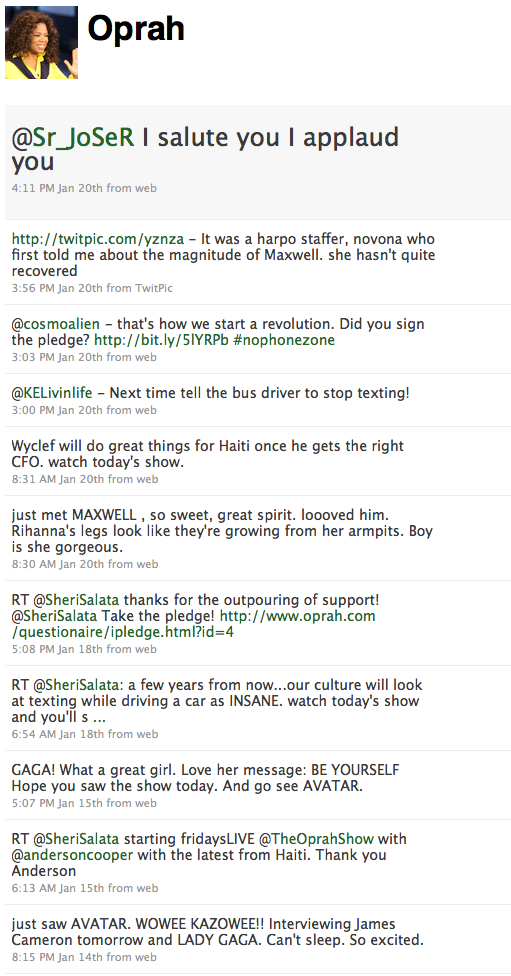
Now that Oprah’s on Twitter, it’s safe to say there’ll be even more attention being paid to this bizarre little service.  Yes, I use it, and yes, I can comfortably say it’s bizarre.  Never before in the history of mankind has the concept of extremely short format person-to-world shouting been possible, and we have a long way to go to until we truly understand the impact.  But in the meantime, with all the new users coming to Tweetersville, I figured I’d put together a handy-dandy guide to help explain some of the Twits you might see out there.

The following translation table should help get you started on comprehending the true meanings of what can be “conversed” 140 characters at a time. Important disclaimer: if you cannot handle cynicism or snarkiness, well jeez, what are you doing reading blog posts at all (here’s a safer place for you)?

If you see someone Tweet… That person is saying…
I’m here in [COOL LOCATION] but am so exhausted from the flight I’m gonna crash. Hey everyone, I got to go to [COOL LOCATION] and you are stuck in your lame place!
Hanging at the Web 2.0 Expo with @Arrington and @Scobleizer I’m at the Web 2.0 Expo and just saw @Arrington and @Scobleizer walk by
Retweeting [FAMOUS PERSON]: … Hey, [FAMOUS PERSON], please notice me!
Just heard a really cool rumor about a big tech company – you’ll get the scoop tomorrow Nothing.
Thanks for following me, I really appreciate it! I’m a big tool that uses autofollowing/autoresponding services, and didn’t even push a button on my keyboard to send you this message. That’s right, it took exactly zero of my caloric output for this waste of bits to occur.
Gosh, I’m sooooo behind on my emails! Rather than deal with my email overload problem, I’m going to waste more time by Twittering.
Heading to the mountains, have a great weekend everyone! Attention 14+ 19 million people, my house will be vacant this weekend. Please review older tweets of mine to determine my home address, then enjoy yourself to my stuff.
OMG, can’t believe I’m going to be on [SOME TV SHOW, PODCAST, OR OTHER "BIG" MEDIA]! so exciting! Yeah, I’m hot stuff, and I want you to know it. This little realm of 140-character communication is neat-o, but the big folks know about me too, because I’m special. My mommy said so, and this proves she’s right!
Holy crap, I can’t believe they killed [MAJOR CHARACTER] on the [BIG TV SHOW] season finale! I am envious of DVR owners and thus comfortable with spoiling the TV show they watch.
Holy crap, I can’t believe [SOMEONE] won/got kicked off [BIG REALITY SHOW]!! see above
Hey, does anyone out there know where you can buy [SOME PRODUCT] in San Francisco? Hey, can someone Google [SOME PRODUCT "San Francisco"] for me? I’m just too darned lazy to do it myself.
Hah, [COMPANY] just [DID SOMETHING], just like I predicted in my blog post 3 years ago. Gosh I’m smart, even though the other 80% of my predictions don’t come true.
[PRODUCT/SERVICE/COMPANY] is so lame/amazing, I hear [unimportant blah blah blah thing] Someone else just said something about [PRODUCT/SERVICE/COMPANY] and I don’t really know it first-hand, but they sounded authoritative while on that phone call I was listening in on in line at the Starbucks instead of minding my own business
Sweet, only 7 more followers until I reach [IMPRESSIVE-SOUNDING NUMBER]! I spend most of my offline time alone, so I could really use a little ego-boost online. Can you spare a follow? Just a quick follow, please! I’ll clean your windshield…
OH: [SOME CLEVER/RIDICULOUSLY INANE COMMENT] I’ve wanted to say [COMMENT] for a while, but didn’t really have the cajones to just say it myself.
Kinda embarrassed to see myself on this list of the Top 50 Amazing [TITLE] List Not embarrassed at all, only bummed that I’m not in the Top 10, because I feel great about the world when my blogger friends write lists to identify cool people and put me in them. It’s pretty sweet
Twitter’s totally lame now that [OPRAH/ASHTON/SOME OTHER ACTUALLY FAMOUS PERSON] is now on it. I’m probably just going to stop using it, or maybe try FriendFeed I used to think 2000 followers made me popular, and now I realize I’m one of the masses again. And I sure don’t like it.
Waiting in a line to get a Frappucino. Or maybe I’ll try an iced chai latte, I hear those are good. Oooh, vanilla scone bites! Yummy! I have lost the fine art of being able to just do absolutely nothing for more than 17 seconds. I tried to just stand here in line, and let an original thought fly through my synapses, but instead I grabbed the nearest gadget I could and did something with it. Please, oh lord, let me be at the front of the line by the time I am done with my 140 characters!

By the way, I put together the list based loosely on Tweets I’ve actually seen… Did I miss any?

Note: if you are looking for help understanding what things like “bit.ly/2lOL2g” or #gov20 or OH/RT: mean, you are in the wrong place.

Why Does Photo Sharing Still Suck?

Wednesday, April 22nd, 2009

I bought my first digital camera in the late 90s, it was a 1-megapixel Kodak that weighed about 14 pounds.  I took terrible pictures onto my spacious 16MB compact flash card, which I copied onto my Toshiba Tecra (running Windows 98).  The ~500K files had fun names like DCP0001.JPG, and I created folders named “Family” and “Vacations” and even created subfolders like “1997″ and “1998″.  Every now and then I’d email a picture or two to a friend or family member, who would look at it in email, and promptly delete it.  Printing a picture was generally a nuisance, and my best guess ratio of pictures taken to pictures printed was around 500:1.

Fast forward to 2009.  My Canon SD850is takes 8MP pictures onto a 2GB SD card (small by current standards), each of which is ~4MB large.  iPhoto automatically sync’s the pictures, which have fun names like IMG_0001.JPG, and stores them in folders named “Apr 5, 2009″ and similar.  Every now and then I email a picture (a manual, tedious process since I don’t use MacMail) to someone, who looks at it and promptly deletes it.  Printing a picture is generally a nuisance, and my best guess ratio of pictures taken to pictures printed is around 500:1, though might actually be as low as 1000:1.

So what’s changed?  Well, I can use Flickr, Photobucket, Facebook, Kodak Gallery, or one of many other sites to host and store my shared photos. The most recent version of iPhoto also has built-in tools to share with Flickr or Facebook, which has certainly improved the process a lot. Of course, I believe in maintaining a certain amount of privacy to familly photos (which represent >95% of my pictures), so only my “Flickr Friends” can actually see most of the pictures I take.  Which means I have to manually generate “shared links” and manually email these to my family, since the bulk of them are not on Flickr.  Further, most of these family members need occasional assistance in either saving local copies or printing photos (and before you go making comments, these are college-educated people who speak multiple languages and have many other fine skills).

In other words, photo sharing still sucks.

The whole concept around requiring membership to sites is stupid, though in an industry where metrics are “registered users”, it’s clear why these companies want it.  Terrible user interfaces dominate these products and services (go sit with a regular person and watch them navigate Flickr for a while – you’ll be stunned at how confusing it is).  Printing photos is easier, yet still a royal pain because most photo collections are unmanaged.  Managing photos is near-impossible due to the change in usage patterns from film cameras (instead of being film-conscious and taking a minimum number of pix, we now opt to take as many as possible, since we know the storage is effectively unlimited).

None of the services seem to recognize the concept that we might, on occasion, want to use a removable drive instead of the one in our computers.  Photo backup, the single most important feature for digital pictures, is effectively a non-existent feature.  I actually know people (again, smart people) who opt to purchase new memory cards when they fill up, rather than synching to computer hard drives.  Facial recognition is finally making the rounds to facilitate “Tagging” – another feature that makes the techies happy yet utterly alienates everyone else.  Other confusing terminology has resulted in me receiving dozens of unprintable photos, yet the sendor being completely unaware that they aren’t sharing full resolution pictures to someone else.

As the kids today say, epic fail.

Here’s what I’m *still* waiting for:

  • Automatic Backup: Okay, if nothing else, build more backup features.  Ask anyone who’s ever lost photos how upsetting it is.  Heck, Geoff Barrall pretty much started Data Robotics (the Drobo company) because of losing photos! Nobody should ever lose a digital photo, everEver!
  • Group Albums: I have a BBQ, and create an album on Flickr called “JT’s MegaAwesome BBQ”, and give a link to all the attendees.  Anyone with a matching email address can, wait for it, upload the photos they took.  They don’t need to “register” or “create an account”.  They don’t need to download special software.  They don’t need to “synch” something.
  • Standardized Tagging: Oh look, there I go calling it Tagging again. Call it categories or keywords or tags or whatever you want, but here’s the thing – standardize it.  Make my iPhoto tags automatically transport to my Flickr tags and have them easily usable when I want to print on SnapFish.  Also, auto-suggesting tags as people type (based on popular tags) would sure help create a consistency around terms (rather than seeing photos tagged with “Paris, France”, “Paris”, “Paris 2009″, “Paris Vacation” etc)
  • Improve the Sharing/Printing: Every photo program or web service should have BIG buttons that say “email to someone” or “share”.  Pushing these buttons should make it really obvious as to whether or not they are sending the Original/Printable version, or just the quick one to view on their screen.  Further, when the recipient receives pictures, make it really obvious to them as to whether or not they have received a printable version, and if not, an obvious way to get it.
  • Work with more address books: Don’t make me “friend” everyone on a proprietary system.  Just talk to my local or gmail address book (or Facebook friends, or Plaxo contacts, or whatever), let me save groups/names, and easily update those I want, when I want.  Even *evite* has this part figured out!
  • Support numerous, flexible storage systems: If I have some pictures on my local drive, others on my wife’s computer, more on my USB drive, some online, and others on my NAS or Pogoplug, so be it.  Somebody needs a photo sharing system that is able to understand the concepts that (1) photos are unique, (2) multiple copies of the same photo will exist, (3) photos will be stored in numerous places, (4) some of the storage locations will not be available at all times (ex: backup drives), (5) all photo metadata should always exist with the photo, regardless of location, (6) facilitating moving these photos around is a good thing.  Got it?

I’m sure there’s a lot more to be done to improve the overall sharing experience.  Better search across photo networks.  Better systems for favoriting across multiple sites and services.  Smarter album/set creation and management.  The list goes on.  What’s amazing is how far we came for a few years (until about ~2005ish), and how little we’ve progressed since.  I believe there remain tons of opportunities for existing players, and if none of them make any smart moves, then maybe some new little players will emerge to take them on.

It’s Official, Twitter is a Cult

Tuesday, April 14th, 2009

I’ve been “tweeting” for about a year now.  As many of my friends know, I joined fairly reluctantly, but felt it was one of those things I just “had” to do professionally.  Over time my use of the service varied, but I tried to stick to using it for mostly professional purposes (with exceptions of important life events, like my hospital stay, the birth of my son, the time I had to wait extra-long at the bus stop, and about that really yummy cookie I got at Specialty’s).  In the past year, Twitter usage has grown leaps and bounds, and their brand awareness is clearly reaching the mainstream.

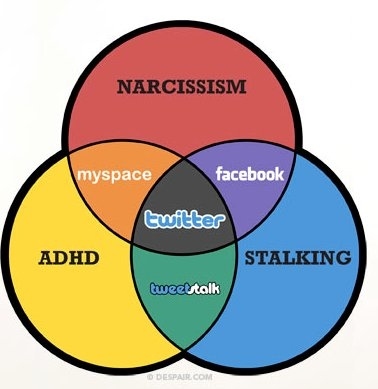
Now there are those who feel this is bad for society, as we reduce content intake to bite-size formats and become headline crazy.  Personally I think this happened over a decade ago, and Twitter is merely the cough to our lack-of-depth cultural pneumonia that’s going around.  That said, there’s something a bit more to the Twitter effect than the other rapid-fire tools people seem to have at their disposal.  When you talk to people who really use Twitter (I’ve tried to do so to find employees, refer business, donate money, rally volunteers, but none of these efforts really go anywhere for me – I think you have to be in the Scoblesphere to actually have impact on your followers), they talk about it differently than virtually any other Web service they use.  Further, there seems to be a little bit more… fanaticism to Twitter than anything else I’ve seen.  I’ll paraphrase the commentary I’ve heard and seen…

“You aren’t on Twitter?  Dude, *everyone* is on Twitter, what are you thinking?”

“Did you see my funny Tweet today?  It got retweeted like 4 times!”

“I’m already up to 600 followers, but I gotta find more.”

“OMG, @garyvee is following me now! I’m special and important!”

To the non-twitterers, this kind of talk is clearly reminiscent of the Smurfs, with more gibberish words being used to describe any derivation of a Twitter-based action.  But as I’ve spent time watching the unbelievable quantity of discussion about Twitter itself, it’s become utterly clear to me.  Twitter is a cult.  Maybe not we’re-all-going-to-live-on-the-great-spaceship cult, but a cult nonetheless.

Warning to the thin-skinned: there are broad generalizations here – if you cannot deal with that as a concept, go here instead!  As sourced by The Internet, a cult can be defined as a group having all of the following 5 characteristics:

  1. It uses psychological coercion to recruit, indoctrinate and retain its members
    Twitter users attempt to get non-Twitter users to join.  They talk about the urgent necessity of being on Twitter (funny video on this). New twitterers are welcomed with very open arms. Gaining followers is rewarded psychologically (go find a single human being not happy with “being followed”), and once a user has a mass of followers, they are highly dis-incented to leave Twitter.
  2. It forms an elitist totalitarian society
    Twitterers tweet to each other, and in person, talk about their tweets.  Twitterers believe that everybody should be twittering.  Non-twitterers are ignored. Companies and individuals who do not use Twitter are belittled, and generally looked down upon.  Having followers is “good”, not having them is “bad”.
  3. Its founder/leader is self-appointed, dogmatic, messianic, not accountable and has charisma
    Okay, this one is a stretch – first, I don’t know the founders at all, and second, from what I do know about them it doesn’t seem like a very accurate claim whatsoever (though they certainly are treated like royalty around the valley).  But instead of thinking about this in context of the individual founders, think of the so-called “twitterati”.  Many “top” twitterers absolutely act these ways.  They make bold claims, talk about the famous people they are meting with, and otherwise spend a lot of time self-aggrandizing on Twitter.
  4. It believes ‘the end justifies the means’ in order to solicit funds/recruit people
    Forget the solicit funds, since we are still waiting to hear about a business model, but again, look at the communication style of self-proclaimed “Twitter experts” and the utter requirement on dragging anyone and everyone into the twittersphere.  People have offered to spend money to be a “recommended twitterer”.  Social Media Consultants tell 100% of their clients they “must” get on Twitter.  And it’s all self-serving – companies “have” to be on Twitter, because “that’s where the conversation is happening” – and by the way, they need to pay someone to get there and pay for advice on how to Tweet and pay for others to “monitor” their Twitter topics.  If topics like ROI arise, they are swept aside by the “importance of the conversation” and being told “all the early adopters are there”.  Buzzword merchants rule the day, and rational business logic is thrown out the window.  Don’t misread me here – there are early adopters on Twitter, and there are plenty of reasons to get your business listening and engaging in the 140-character-at-a-time shouting match, but the manic rush to push big business there is truly amazing.
  5. Its wealth does not benefit its members or society
    As I linked to above, studies are showing the concerns of impact Twitter may have on society. Personally, I found myself agreeing with many points raised.  As I saw what I will call “prominent” technology Twitterers reacting to the article, their comments treat it with disdain.  Why?  Because it’s a threat to the foundation that Twitter must be good.  While I have seen a few examples of people using Twitter to actually produce a benefit (raising some money, rescue stranded bloggers from the desert, etc), it’s pretty hard to justify other true benefits.  It certainly occupies time, and is unquestionably a fascinating method of communication (albeit a fundamentally broken one), but I’d wager a fine penny that heavy Twitter users are not healthier, happier, or otherwise more satisfied with life than the poor schlubs out there limited to such primitive tools as the phone and texting to just one person at a time.

Quick update: Just read “Twitter Leads to Immorality? C’mon!” – one other common attribute of a cult is the complete inability to handle negativity nor criticism about the cult itself.

Now before anyone massively overreacts to my statements (oops, too late, the angry reactions probably got written as comments/tweets long before most readers would even get this far), I’m not saying “all Twitter use is bad”!  But maybe we need to really consider the role it plays and how we could and should use it.  I fundamentally believe it is not creating “a community” and I am also deeply concerned about the combination of “Attention Grabbing Headlines” with the lack of responsibility used by many Twitterers (urban myth perpetuation, worms/attacks, and, of course, Rickrolling).

If there’s one thing I do believe is that Twitter is pushing us even further down the perilous road of “instant reporting”, regardless of the news or facts about a situation.  Fact-checking is all but dead in traditional writing, let alone 140 character chunks.  This pace is part of the contribution to the “work creeps into personal time” calamity modern society faces. Yes, it’s a calamity – did you know that when we were hunter-gatherers the average human “worked” for about 17 hours per week?

How to solve the problem:  calm down about the Twitter.  Don’t have to stop.  Don’t have to quit.  But also… don’t have to have 50,000 followers.  Don’t have to be retweeted a hundred times a day.  Don’t have to have everyone know every intimate detail of your day.  Don’t call me up to tell me about a cool tweet you wrote. Don’t try to recruit your grandpa to sign up.  Don’t expect every company to beckon to win your love just because you wrote (something negative) about them in 45 seconds.

And, of course, don’t expect a free latte just because you have some followers.

Introducing Legacy Locker

Tuesday, March 10th, 2009

It’s with tremendous pride and excitement that I use my first blog post in over a month to announce the launch of Legacy Locker. I’m one of the founders of the site, and I wanted to share a little backstory to where it came from and how it got here.

Two different personal events occured to me in the summer of 2007 that led to the conception of Legacy Locker.  My grandmother unfortunately passed away, but at the age of 94 it’d be hard to say she didn’t live a full life.  She and I used to exchange emails, a pastime of hers she also enjoyed with other friends and family around the world.  My father and I tried to figure out a way to get into her Hotmail account, but had no luck and basically the account is, for all intents and purposes, unavailable.

On a more uplifting side, my wife and I had a son earlier that year, and in the summer sat down with an estate planner to establish a will (did you know in the state of California that if you don’t have a will/estate/trust, probate attorneys will claim 4% of your assets, including your life insurance money?  scam).  Anyhow, after literally hours of discussing my family tree and my various assets (car, 401k, signed Jean Beliveau picture, etc), I had a huge binder: our “estate” (I always pictured something with a mansion).

Last summer on a flight (yup, I remember that well), I had one of those “moments” in life, where I realized that while my physical assets were protected in my estate plan, I had nothing in place to deal with all of my online goods and assets.  My computer’s password, my email accounts (all 5 of them), my Amazon store credit, my wordpress login, etc.  If anything happened to me, virtually all of these assets would become literally inaccessible to my wife (or others), despite the fact that I had a will.  While they were legally protected, in all practical terms they’d become effectively worthless (including the 70+ domains I own through GoDaddy).  Legacy Locker was born.

JT and AdamWhen I returned home, I talked with my wife about the concept, and she completely recognized the need as well.  I went to my business partner Adam, he too thought it made sense.  I talked to a few other friends and close colleagues, and not a one said “nah, dumb idea, what are you thinking?”  So Adam and I raised some money, and hired a team to get things done.

The site is pretty simple to actually use and understand.  Users register, fill out a profile, and assign verifiers (people they trust to confirm their passing).  Next, they create assets and beneficiaries.  An asset is the online account information to a website, basically a username, password, and some notes.  The beneficiary is the person they’d want to receive the asset.  The last feature is called “Legacy Letters”, which are emails that get sent to family, friends, or colleagues with a “goodbye” note (in the future we’ll incorporate video as well).  For more on how it works, click here.

So this morning the site goes live.  The actual working service won’t come online for a few more weeks, as the final touches get put in place.  We’re looking forward to getting everything up and running, collecting feedback, and building a great service.  Our primary goal is to bring Legacy Locker to the attention of willmakers, attorneys, and estate planners who help service the 12.6 million households who have wills in place (and 900,000 new people every year), hence our slightly early launch.

I’ve been building consumer technology, from gadgets to websites, for the past 13 years.  While I’ve worked on some amazing products in my time, this is my first opportunity to use technology in a way to truly help people.  Thinking about loss is hard (which is why not enough people do backups and only 1/3 Americans have wills to protect their families).  Dealing with loss is even harder, and if we can help make that part of life a little easier for some people, I consider that a great accomplishment.

Thanks,
Jeremy

ps – sorry about the no blogging all month thing – I was in the hospital dealing with a nasty combination of appendicitis and Crohn’s disease, but I’m doing much better now thanks!

50 Common Words with Wacky Google Results

Saturday, January 31st, 2009

I was trying to figure out how much a bucket cost earlier this week, and googled “bucket” to find out.  I was surprised to discover that anything remotely useful didn’t show up in the first few results.  So, in some bizarre method of either wasting hours of my life or providing complementary services to the SEO folks out there, I went looking for other common, everyday words who had similarly weird results in Google.  This list is not in order of wackiness (but I did consult this list for help).

  1. Bucket.  Some “real” results, but otherwise dominated by Photobucket, a movie, and other miscellaneous non-buckety stuff.  Nothing as cool as the results for spatula either.
  2. Word.  Completely dominated by MS Word, or products that in some way augment MS Word.
  3. Thing. After a comic book, the next few entries Google showed me asked me if I really meant “thong”. Well, I do now!
  4. Seven. The only single-digit number whose top results had nothing to do with numbers.
  5. Live. All MSN, all the time.
  6. Stop. All sorts of goofiness, the highlight being a link to sign up in order to help stop alien abductions. I do not lie.
  7. Run. Nothing super-wrong about the results, but they’re all over the map.
  8. Sea. Instead of a picture of the ocean, the top result is a convenient map showing you where the Seattle-Tacoma Airport is located.  Just in case.
  9. Saw. (get it? sea-saw?) While these aren’t inaccurate results, I most certainly pity the squeamish individual who is innocently looking to pick up a woodworking tool.
  10. City. I’d like to applaud the City of Chicago for being the number one city!
  11. Country. Yeesh, not only isn’t there a country at the top of the list, it’s dominated by country music.
  12. Sad. Nothing out of the ordinary for “happy”, but sad was really sad.
  13. Dirt. Another one dominated by movies & TV.
  14. Table.  Great for people looking for some HTML advice. Awful for the other 99.8% of humans.
  15. Bug. (yeah, I’m cheating here) Top results include the animated film and Bug Labs.  Cool to me, probably would confuse some of my relatives though.  :)
  16. Apple. Not a fruit-related link in sight.
  17. Orange. While incomparable to the previous entry, it too is at risk for scurvy.
  18. House. Mostly TV shows and a little government to “mix it up” a bit.
  19. Plasma. I only included this one because it was surprising how few of the first results were about plasma TVs. Go fgure.
  20. Lamp. Way out there.  Even the Latin American Microform Project beats out a nice table lamp!
  21. First. Then again, I doubt anyone would be interested in the word first contextually anyway.
  22. Remote.  Results are quite poor for the outdoorsy users.
  23. Well. A couple of entries for a poor place for babies to play, but a bank manages to top the list.
  24. String. Ah, I see that luxury knitting yarns did eke out super string theory, but these were both buried beneath programming terms.
  25. Chip. No silicon or potato references on page one!
  26. Ball. Results show that high society is not very good at SEO.
  27. Angel. Ditto for religion!
  28. Force. In a slight twist, I’d like to applaud the Internet for only 2 of the top 10 results having a Star Wars tie-in.
  29. Falcon. If it weren’t for a Wikipedia entry you’d never even know about the bird.
  30. Owl. Similarly suffering from a lack of ornithology enthusiasts.
  31. Small. The only small thing here is the number of results about small things. Bah-dum, ching!  Don’t forget to tip your waiter!
  32. Big. Insert some Biggie Smalls reference here (it ties the two lines together so nicely).
  33. Wall. Clearly the people in Wall Township were tired of losing traffic to their home page.
  34. Star. Another example where the geeks are just disappointing us all.
  35. Smart. Well, the results aren’t…
  36. Dumb. After losing quite a few minutes to some of these, I figured I’d include it to share the painlove.
  37. Sharp. Lots of consumer electronics, not much about knives.
  38. Girl. Exactly as one would expect, a link to a skateboarding company.
  39. School. A coup for the Montgomery County Public School system. A big fail for anyone not from Rockville, MD.
  40. Robert. Amazingly this no longer goes straight to the Scobleizer himself.
  41. Pop.  I think this effectively ends the pop vs soda debate.
  42. Bowl. Very understandable results, placing lingerie well above ceramics.
  43. Cake. Not terribly abnormal, but I really wasn’t expecting a stock quote that was highly contextual to my interest in a tasty dessert.
  44. Store. A highly arbitrary list of retailers.
  45. Trend. I guess anyone on top of the trends probably isn’t googling this one too often.
  46. Ego. Even paintball products managed to place themselves above any of the “a-list bloggers”… ;)
  47. Past. In a dismal sign for smart people everywhere, google assumed I meant “PSAT” and then provided me with lots of resources to do a better job on the exam.
  48. Bail. Seems to be missing links to rich bankers and/or automakers.
  49. Toe. No links to me or my Dad, whatsoever.
  50. Failure.  I was quite disappointed to find that failure no longer linked to Bush’s bio.  Not to worry, I think we all know it pretty well anyway…

So what’s the point, you might wonder?  I didn’t really have a “deep mission” here to uncover some secrets of the universe, but it was interesting nonetheless (especially since I googled at least another hundred or so “common” words to find the results above).  As we continue down the path of defining our world more and more by what we find with a simple google search, I hope we don’t every end up putting too much faith in the almighty from Mountain View.  Google search, as I’ve discussed before, is not “reality” and it’s cleary not a digital reflection of the world we live in.  If it was, bucket makes, models, vendors, and pricing would’ve been much more prevalent than some mediocre movie.

eStarling is Startlingly Cool

Tuesday, January 6th, 2009

eStarling makes several WiFi connected digital photo frames, and I’ve been playing with their Impact V for a bit.  I’m impressed.

From the moment you open the box, eStarling does a pretty good job holding your hand and making use of the frame pretty simple.  You have all the usual options for displaying pictures that past digital frames have lead us to expect, including memory card slots that accommodate a couple different card types (SD, MS, MMC.)  But what’s way more interesting to me is the wireless and social mechanisms for displaying pictures.

When you pull the device out of the box, a greeting card immediately invites you to plug in the frame and connect it to your wifi connection (beware: this frame is much cooler if you have a wifi network.)  Once you’re connected, the frame prompts you to visit their website and activate your account.  Once you do you will get an email address dedicated to your frame, and you (or your friends and family) can email pictures to your frame.  You can also log into your account on their website to upload pictures from your computer to your eStarling account – these will then appear on your frame (it took my pictures about 15 minutes to show up.)  One of the neatest features is the social component – you can link your frame to a variety of social websites and services, including Facebook, Flickr, Phtobucket, Picassa, Twitter (not sure about this one), YouTube and more.   In addition to these services, you can also subscribe to RSS feeds – popular ones like National Geographic or even a user-designated feed.  You can also post small videos to play on your frame if you so choose.

I did have some issues with some of the social services.  For instance, I linked my Flickr account to my eStarling frame.  It was a pretty simple, one-click connection which presumably links up eStarling’s service with Flickrs API.  Two issues presented themselves though:

1. After clicking through the Flickr to link up the accounts, instead of a “Success, awesome job, well done!” screen, I was presented with a page full of gibberish.  There was no message to tell me whether I had successfully linked the account.  I didn’t know for sure until photos started appearing on the frame.

2. When those photos did appear, they weren’t mine.  They were photos of friends mine, people to whom I am linked on Flickr.  But none of my own photos made it into the frame.  Now, I like my friends and all, but I don’t need their photos on my frame.  Whether it’s going to sit in my home, or in my parent’s home, I want my own pictures on my frame.

Ultimately I was forced to use the “custom RSS” feature and take my Flickr account’s own RSS feed and manually link that with my frame.  Even after doing that, only my most recent set (about 20 pictures or so) showed up on the frame.  I don’t really know how to pull specific sets or additional photos from Flickr into the frame.

The frame has an eight inch display (800×600 pixels) and the clarity is pretty darn sharp. (Any blurring in the images in this post is due to the photographer, not the frame.)  It’s a touch screen interface, and there are light-up touch screen buttons along the right side.  You must use the touch screen in order to connect to the wireless network, but almost everything else can be accomplished through eStarling’s web portal.   The touch buttons let you skip through photos, or jump back to menus to select specifc photos, or access settings for the frame.  But I found the touch buttons a little finicky to use – fortunately the included remote also allows you to control action on the frame.

Lastly, there’s packaging.  In the unboxing I discovered very little wasteful or non-recyclable material.  There was one small piece of closed-cell foam for padding, and a foam sleeve for the frame.  Everything else was cardboard, including the majority of the boxe’s padding.  5 gold stars for being conscious of the environment.

Overall I was impressed with the frame.  The picture clarity, the simple setup, and the social components were all fantastic.  I love that it’s wifi, and I dig the fact that I can update the photos remotely, up to and including if the frame is in another state (or country.)  However, I do think the web interface and tools need a little refinement.  They are feature-rich but lacking in the fine points of usability.  Some improvements could include better feedback to user actions (letting you know if you succeeded in linking an account), and better fine-tuning of services (to include / exclude friends’ photos, etc.)  They don’t need more options, they just need to refine and improve the ones they’ve got.

eStarling Wireless Digital Photo Frame on 12seconds.tv

Daniel Lim at Slashgear also wrote a nice review of this frame.  If I were forced to give this frame a numeric rating, something which I am loathe to do, I would give it an 8 out of 10. They did a good job.  I just hope they keep improving the little sucker, especially the web interface and options.

This post is also available on 1TO10REVIEWS.

Twitter Scam Proves Early Adopters Don’t Know Everything

Sunday, January 4th, 2009

I visualize technology adoption like a huge wave crashing to shore.  At the tip of that wave’s crest are the newest of new technologies, such as FriendFeed and Plurk.  As the wave advances, they’ll either gain usage amongst a wider audience or dissolve into nothingness.  Below the tip are still new technologies that are trying to “cross the chasm” into the mainstream, such as Twitter – they might make it, or also just fade away.  Next up we have technologies that spreading to the masses, like Facebook and blogging.

From my time here in Silicon Valley, I’ve noticed a tendency that the “higher ups” on the early adoption wave tend to look down upon the rest.  Sometimes the smugness is so thick it’s as if those users who don’t microblog are busy using whiteout on their monitors while wiping a lingering trail of drool off their chin.

Over the weekend, it turns out someone tried to “phish” Twitter users, and achieved enough success to warrant widespread coverage by bloggers and online media. The official Twitter blog stated:

It looks as though this particular scam sent out emails resembling those you might receive from Twitter if you get email notifications of your Direct Messages. The email said, “hey! check out this funny blog about you…” and then provided a link. That link redirected to a site masquerading as the Twitter front page.

If you didn’t look at the URL of this false Twitter page, then you might not have noticed that it was actually just a page on the domain access-logins.com which was also faking Facebook’s front page. We immediately reported the offending domain (and warned our friends at Facebook). The site is now on OpenDNS’ and Google’s reported phishing lists.

So if you’ve ever had someone make fun of you because you aren’t using the beta version of an operating system, don’t lifecast yourself while making potty, or still have to push multiple buttons on your cell phone, this is your time for a Nelson-ish “haa-ha”.  Now I certainly don’t wish success to anyone using malicious activites like this online, it’s truly bad for everyone.

But maybe all the “I’m-so-cool-and-you’re-on-MySpace” attitudes of so many echo chamberites, maybe your horse ain’t so high after all?  Maybe a few of the people who got suckered in can help build better interfaces to their technologies so our less technically savvy friends don’t have to feel stupid when trying to adopt new stuff?  I have three “what I hope we all learn from this” statements:

  1. Being an early adopter doesn’t make anyone “better” than anyone else, and clearly not smarter.
  2. Product/interface designers need to do better jobs at making their technology more approachable.
  3. Internet companies, as a whole (Google – I’m calling you out here – you need to make spammy search results go bye-bye), are failing to protect consumers from those with malicious intent.

10000 followers won’t get you a free latte

Sunday, December 28th, 2008

Guess how much attention the following tweet garnered from MUNI (the San Francisco transportation organization)?  Answer below.

A lot of bloggers worked each other into a bit of a tizzy this weekend as they debated the merits of a Twitter feature that would allow one to sort search results in the order of users who have the most followers.  The debate wasn’t really about the feature itself, which is completely innocuous conceptually (Twitter search should allow tons of different sorts).  The debate was about Loic Lemeur (the original poster) using the term “authority” to define his request.

I’ll be as blunt as possible: the number of online “followers” (including Facebook friends, blog subscribers, and all the 19-year-olds on Friendster who genuinely want to meet old dorks like me) one has is not a measure of authority.  It is not a measure of power.  It is not a measure of intelligence. It is not a measure of capability.  It is not a measure of quality.  It is a measure of reach/audience, and if one wants to put a label on it, it’s called “popularity”.

In high school I ran for class president.  I lost.  The winner went to all the cool parties all year long, I went to few.  The winner was on lots of teams and associations, I was on several.  During our speeches, the winner talked about how great the school was and how much pride she had.  I spoke about getting the class to volunteer with a local in-need youth group.  In truth, little of this all mattered in the election, since I wasn’t a very popular kid in high school (yeah, that’s right, the guy who programmed C++ and ran an online BBS in the late 80′s wasn’t super popular, can you believe it? have no fear, I blossomed).

I really like something Robert Scoble wrote this morning:

Here’s why I’ve been saying for the past year that it is far more important who you follow than who follows you: if you follow people just to get followers you’ll end up being overworked, deep in information overload, and superficial to boot. You won’t have a philosophy. It +will+ show. You might be able to fool most of the idiots most of the time, but eventually they’ll see the difference between the “collect follower” types and the “surround yourself with smart people” types like Tim O’Reilly or Jay Rosen.

I can smell the “follow me” types a million miles away, can’t you?

I’m an idealist at heart.  Ideally one wouldn’t even be aware of quantity of followers.  Ideally one wouldn’t know their blog subscriber count.  Personally, my favorite “stat” is seeing responsive blog posts externally or comments on my blog posts and/or friendfeed entries.  Comments imply I’ve done something interesting enough that someone else chose to interact with it.  And that’s what excites me about being a content creator online.

ps – the question at the top of the blog post was rhetorical, sorry about my clever ruse.