Archive for the ‘Product Announcements’ Category

SanDisk Announces iPod Nano Fighter At CES

Thursday, January 5th, 2006

The Sansa e200 series features a slim new design and a 1.8-inch (4.572 cm) TFT color screen (QCIF+) along with high-quality audio, photo viewing and video playback capabilities. It offers an industry-leading, 6GB capacity that holds more than 1,400 MP3 songs. It is also available in 2 and 4GB models. Its large color screen is ideal for easily viewing playlists, photos and personal videos.

Its distinctive, high-strength and lightweight back cover is made with an advanced Titanium alloy from Liquidmetal® Technologies that is stronger than steel and highly resistant to scratches and wear. It includes a rechargeable Lithium-Ion battery for long playtime and can be replaced by the customer to ensure the player provides many years of continuous service. Dimensions of the Sansa e200 are 1.7 in. wide x 3.5 in. long x 0.5 in. high (4.4 cm wide x 8.9 cm long x 1.3 cm high).

For instant access to millions of digital songs, the Sansa e200 series players will support Microsoft® PlaysForSure™ so consumers can download and pay for songs individually or download an unlimited amount of music for a flat monthly subscription fee from music stores such as Rhapsody To Go® and others.

The Sansa e200 will be available in the spring in 2, 4, and 6 GB capacities. With a color screen, and support for displaying photos, as well as MP3′s and WMA’s, and even videos this clearly has the iPod Nano in their sights. Of note, to keep the small form factor, they’re using microSD flash cards. An icon based menu system, and a replaceable lithium ion battery complete the package. It will be priced to match Apple’s Nano at $200 for the 2 GB, $250 for the 4 GB, and $300 for the 6 GB model.
See some more info here.

Mobile Broadband Notebook PC

Thursday, January 5th, 2006

HP today introduced a mobile broadband notebook that allows users to stay connected at broadband speeds to corporate networks, email and the Internet without being tied to a wireless hotspot.

The HP Compaq nc6140 Notebook PC operates on Verizon Wireless’ Evolution Data Optimized (EV-DO) network, which allows customers to connect at broadband speeds to corporate networks, email and the Internet, even while traveling.

The notebook features integrated dual-antennas and pre-installed software to help establish a convenient and reliable wireless connection via Verizon Wireless’ BroadbandAccess network. HP and Verizon Wireless will jointly market the new business notebook.

“Mobile professionals using HP’s mobile broadband notebook no longer have to limit themselves to airports, hotel lobbies or other public Wi-Fi hotspots,” said Ted Clark, senior vice president and general manager, Mobile Computing, HP. “Our customers can now enjoy extremely fast data connectivity speeds, enabling them to communicate better and be more productive wherever they happen to be.”

HP and Verizon Wireless collaborated on the development of the nc6140 notebook to take advantage of the Verizon Wireless EV-DO network that powers its BroadbandAccess service and offers download speeds of 400 to 700 kbps. The notebook also incorporates the QUALCOMM MSM6500(tm) CDMA2000(r) 1xEV-DO high-speed wireless chipset.

“Together, HP and Verizon Wireless provide mobile professionals a robust wireless broadband experience without having to seek out and find public Wi-Fi hotspots in order to connect with email or the Internet,” said John Stratton, chief marketing officer, Verizon Wireless. “The Verizon Wireless BroadbandAccess service and our EV-DO network that supports it provide the advantages of convenience and flexibility.”

For the serious internet user on the go, this is an advancement forward. The nc6140 notebook features EV-DO card built into the device. No more add in cards, or flimsy antennae. The monthly price of $59 for exisiting Verizon Wireless customers is not unreasonable considering the price of other broadband offerings. The best part is, no more running around the airport to find the WiFi hotspot, it truly is everywhere.
Read the full press release here.

Belkin CableFree USB Hub

Wednesday, January 4th, 2006

Belkin announces its new CableFree USB Hub, the industry’s first USB Hub that does not require a cable to connect to the computer. This Hub allows people to place their laptop anywhere in the room while still maintaining wireless access to their USB devices, such as printers, scanners, hard drives, and MP3 players. This is the first UWB-enabled product to be introduced in the U.S. market. The CableFree USB Hub’s wireless functionality is enabled by Freescale Semiconductor’s ((NYSE:FSL, FSL.B) Ultra-Wideband technology.

CableFree USB will be on display at the 2006 International CES Show in Las Vegas, NV, January 5–8, at 31247 South Hall and at Macworld Conference & Expo in San Francisco, CA, January 10–13, at 717 South Hall.
(more…)

Blu-ray double-whammy

Tuesday, December 27th, 2005

Alas, those waiting for Blu-ray to hit the market can truly begin planning their next-generation optical drive honeymoon: today Pioneer announced that it will be releasing Blu-ray products starting *gasp* at CES next month (starting January 5th!). On top of that, regions for next-generation DVD formats were just announced! (Say it ain’t so, Batman!) Anime freaks, your time has come; the U.S. and Japan will be joined in a sacred electronic union as two of the nations crowned with Blu-ray region 1 status. Joining the behemoths will be powerhouses South America and east Asia (sans China).

Maglite Goes Digital

Tuesday, December 27th, 2005

Now, after years of research & development, testing and refinement, Mag Instrument is committed to introducing, in early 2006, a line of MAG-LED™ flashlights. Like Mag’s incandescent-lamp flashlights, these newest members of the Maglite® flashlight family will have the style, performance, benefits and features that both professionals and consumers have come to expect from a Maglite® flashlight, including the fact that they are built for a lifetime of service. The Maglite® design tradition will be instantly recognizable in them, and they will offer the beam-focusing capability that has always been a feature of Mag® flashlights, AND MORE!

So, the American icon of flashlights, is entering the digital age. Some LED flashlights are very bright, and are able to provide a lot of light time between battery changes. I can’t wait to get my hands on one of these!
More info here.

Ridata Unbalanced SD Memory Card

Wednesday, December 21st, 2005

Advanced Media, Inc., manufacturer and marketer of the popular RIDATA brand of recordable CD and DVD media, electronic storage products, and digital media accessories, is adding an unbalanced Secure Digital memory card to its RIDATA line “Our unbalanced Secure Digital memory card is further indication that Advanced Media is dedicated to providing its customers the latest advancements in electronic storage media,” remarked Charlie Shiang, VP of Flash Products “This fast card enables users to store specific navigational or mapping information for use in a variety of mobile devices. It can also be used to hold trip details and highly detailed charts.”
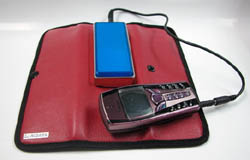
The applications are unlimited, any type of digital content provider with the consideration of protecting the intellectual content while in need to be able to sell or populate the whole content will definitely benefit from the Unbalanced SD card, more examples include educational markets, remote learning education, automobile and defense industry ” added Shiang.

The uses for this product will be centered on two parts of SD memory formation: encrypted output control segment and accessible data segment. The data stored on the Encrypted output control segment is strictly prohibited for any kind of “check-in” (write data) or “check-out”(export data) activities with any other devices. Any form of the data movement is actually impossible.
(more…)

Solar Powered Battery Chargers

Monday, December 19th, 2005

Advanced Media, Inc., manufacturer
and marketer of the popular RIDATA brand of recordable CD and DVD
media, electronic storage products, and digital media accessories, is
adding two photovoltaic solar powered battery chargers to its popular
RIDATA product line. Model SP 3900 charges cell phones and any
electronic device that has USB connectivity, such as Cell Phones, MP3
players, PDAs, GPS, hand-held games, radios, etc. Model SP 1300 charges
up to two AAA and AA batteries. Both will be on display in the Advanced
Media 2006 International CES booth, South Hall #35320.

“Solar power chargers may be the most important and most significant
addition to the electronic and battery accessories industries ever,”
said Harvey Liu, Advanced Media president. “They allow battery-operated
devices and batteries to be charged virtually anywhere in the world
without having to worry about a compatible electric outlet being handy.
Besides its convenience factor, solar power also is environment
friendly – clean, renewable – and absolutely free.”

Both RIDATA photovoltaic solar-powered chargers are lightweight,
durable, and waterproof. Each is as efficient as any current
conventional charger. The company believes individuals who are
concerned with energy costs as well as those who favor green energy
will be attracted to its solar chargers. Additionally, the SP 3900 will
find favor with travelers and campers, while the SP 1300’s attractive
design will also draw individuals to it.

The SP 3900 is a three-panel solar-powered charger with a 900mA power
bank. It will charge cell phones and any device with USB connectivity.
Typically, it will fully charge such items in direct sunlight in four
hours.

The SP 1300 charges AAA or AA batteries. It will fully charge two
AAA-size units in five hours in direct sunlight and two AAs in 10
hours.

One of the main pluses of solar power is the fact it is renewable. That
is, as long as it keeps shining, the sun will be an excellent source of
energy, and scientists believe that should be for at least another 4.5
billion years. It also produces no air pollution, little or no noise,
and requires no transportable fuels. Even on cloudy days, there is
still enough solar energy for these chargers to do their job, albeit
not as quickly.

For all those folks that need their batteries on the go, this will be a must have item. Any card carrying Greenpeace member will also want this in their bag of tricks. I hope this starts a trend of solar charging, as this will be convenient, and good for the environment.

New Hi Gain Antenna

Friday, December 16th, 2005

The HWU8DD is designed to connect your desktop computer or laptop easily to any Wireless-B or Wireless-G network via a USB connection. Hawking’s award winning Hi-GainTM Antenna technology extends wireless connection distances by up to 300%. The HWU8DD is equipped with a new 8dBi Directional Dish antenna that provides more distance and better speeds than other wireless adapters on the market. The Hi-Gain Wireless-G Dish Adapter is the only wireless adapter to integrate the distance benefits of wireless Dish Technology with WiFi networking. The built-in LED signal strength indicators provide network signal information to pinpoint the strongest signal available within your area.

Read the original press release.

Wireless USB

Friday, December 16th, 2005

Wisair is determined to take USB cables off of the personal computer. The company has taken another step in the Ultra Wideband (UWB) industry with the release of a Wireless Universal Serial Bus (WUSB) reference design.

The new reference design includes a WUSB PC dongle and a WUSB hub, providing consumer electronics and peripheral manufacturers with the means to offer customers wireless connectivity to existing USB-enabled devices.

Printers, scanners, remote hard disk drives, digital cameras and mobile phones are able to plug directly into the WUSB Hub and receive wireless connectivity to a PC. The WUSB Hub replaces any wireline USB connection with a wireless connection.

We had heard that wireless was the direction for the 3rd generation of USB products, but this is the first actual product I’ve seen. Between the omnipresent WiFi, and the sexy Bluetooth products, Wireless USB may be a little late to this wireless party. On the other hand, most of the Bluetooth gear is expensive, and most computers do not ship with a Bluetooth transmitter built in. If the USB folks could integrate their transmitter into their existing USB chips, and the new computers shipped with it built in, they may leap frog Bluetooth in this game. In the meantime, I look forward to not having so many cables around my desk!

See here, here, and here for more info.

Advanced Media Introduces USB Flash Drive / Laser Pointer Combo

Thursday, December 15th, 2005


Advanced Media, Inc., manufacturer and marketer of the popular RIDATA brand of recordable CD and DVD media, electronic storage products, and digital media accessories, is adding yet another advanced product to its lineup of electronic storage media. Its new high-speed RIDATA Laser Pointer USB Drive features a USB 2.0 flash drive with a laser pointer. It is set to be shown at the upcoming 2006 International CES show.

“Our new, easy to use RIDATA thumb-sized portable USB flash drive with laser pointer enables users to securely exchange huge amounts of data between computers or notebooks with a USB port,” stated Harvey Liu, Advanced Media president. “Its plug-and-play simplicity makes connecting to any computer a snap, allowing access virtually anytime, anywhere. No power supply or external cables are required.”

The versatile USB drive also features four new useful functions:

Auto Login: This is a convenient application that automatically enters IDs and passwords from a database created on the USB Drive to Web sites. With Auto Login, users can carry all IDs and Passwords on the USB Drive.

Bookmarks: This feature saves the user’s own Web bookmarks to the device, allowing easy access to them from whatever computer that is connected to the device.

FLASH Mail: A small Email software program, that allows users to access email from the USB Drive.

Secret ZIP: Creates a Secret folder and a Zip folder. This allows users to zip a file by simply dragging the file to the ZIP folder, or a encrypted Zip file by dragging into Secret Folder.

With high storage capacity and blazing fast speeds, the handy RIDATA USB Flash Drive with laser pointer is an ideal choice to replace floppy disks, ZIP disks, and hard disks. This high-speed USB flash drive performs data transfer at a rate up to 19MB/s for read and14MB/s for write in dual-channel mode, and up to 10MB/s for read and 7MB/s for write in single-channel mode.

It supports multiple operating systems: Windows® ME, Windows® 2000, Windows® XP, Mac TM 9.x or later, Linux TM Kernel 2.4 or later (no driver needed); Windows® 98 and Windows® 98SE (driver enclosed). It also comes with a security lock (Safety Zone); is shock proof; and has power-saver functionality. An advanced software package is included.

The class II laser pointer has an average wavelength of 650nm, and will make a 0.4-inch spot from approximately 11 feet. It meets TUV, FDA, and ROSH requirements.

The RIDATA Laser Pointer USB Drve is available in 128MB, 256MB, 512MB , and1GB capacity sizes. It has an MSRP of $69.99 based on 512MB capacity.

This sounds like a great idea for a combo item. I always carry a USB flash drive, having a laser pointer handy would be a plus. I’m also intrigued by the email and bookmark utilities included on the device as I see these flash drives making it easier for users to take their settings between computers. We’ll work on getting on of these in the lab for a full once over!

Eight Gigs of RAM!

Friday, December 9th, 2005

Samsung Electronics Co., Ltd., a leader in advanced semiconductor technology, today announced that it has solidified its leadership position in the server memory market with a new 8GB product offering. Following the introduction of its
8GB Registered Dual In-line Memory Module (R-DIMM) in October, Samsung has now increased the density of its Fully Buffered Dual In-line Memory Module product line-up (FB-DIMM) to include 8GBs by adopting 80 nanometer 2Gb DDR for high-speed servers. This represents a significant leap forward in advanced server memory architecture.

OEMs that use Samsung’s high-density memory can increase the amount of installed memory and keep slots in reserve for future upgrades. Samsung memory such as the new 8GB FB-DIMM is ideal for space-constrained applications in blade and 1U servers.

The FB-DIMM architecture overcomes the previous limitation of two-to-four module capacity per channel.
A FB-DIMM system’s DRAM module content can be increased to as many as eight modules without reducing the speed. The new system can also process an increased amount of data at the same time with the advanced memory buffer (AMB) chip connecting each module in the system point to point. As a result, the server market demand for high density DRAMs is expected to increase significantly.

With Samsung’s high-density memory modules, designers can take full advantage of increased memory support in the latest server operating system to maximize performance. In addition, Samsung is offering next-generation memory solutions such as the 8GB FB-DIMM to allow servers to benefit from ultimate memory density and bandwidth.

Samsung’s complete product portfolio includes all variations of DRAM memory from DDR to DDR2, and R-DIMMs to FB-DIMMs with densities ranging from 512MB all the way to 8GBs.

For those of us with an insatiable appetite for memory, this may fulfill it for a while.

From Akihabara.

E-Ink Watch

Tuesday, December 6th, 2005

The Japanese company Seiko will release a limited edition of 500 units of their Spectrum SVRD001, the first watch in the world that uses flexible e-paper or Electrophoretic Display (EPD). The design of the watch is similar to a bracelet and the body is made of stainless steel and a black & white e-paper. The price of one of these 500 units is an extremely affordable 1900 EUR. It will weigh 134g and will be 37mm thick. It will be available worldwide in January 2006.


This may be one of the first products to come to paper that uses the e-ink technology. E-ink promises to have a high contrast surface, with a minimal power consumption. It uses electrostatically charged balls as the basis for its display.

From Popular Technology and Akihabra News.