Archive for the ‘Product Announcements’ Category

From My Mouth to Lenovo’s Ears

Monday, December 22nd, 2008

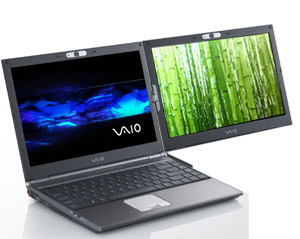
July 27, 2008.  I write a blog post outlining the details of how to properly design a laptop with two screens. The main concept:

Start by thinking of a thin-screened laptop like the (now former) Sony Vaio SZ series. Imagine on the side (left or right - you pick) a hinge, and on the other side a clasp. You release the clasp, then a second screen swivels out (via hinge) to appear next to your original screen. Attentive readers will realize at this moment that the screen is facing away from the user, which means the hinge needs a swivel as well (just like on a tablet PC). That’s the basics, but read on for it to all make a bit more sense. Also, I’m not stating that this configuration is for everyone, but, like a mini-notebook, it should appeal to… some?

December 18, 2008.  I read on Engadget and the Technologizer that Lenovo is planning a dual-screen laptop.  The main concept:

it looks like the dual-screen W700 is for real. Reportedly, the machine will feature a 17-inch WUXGA (1,920 x 1,200) primary display along with a 10.6-inch WXGA (1,280 x 768) secondary panel. Think SideShow, just jacked up on whatever Clemens and McGwire were using. The rest of the specifications are swell but expected, but the tidbits we’re really reaching for (price and availability, naturally) are nowhere to be found. Can you say “want.”?

I don’t suppose they’ll be sending me a royalty check any time soon, eh?

LIVEdigitally Alum Launches Site for Crowdfunded Journalism

Monday, November 10th, 2008

When I first met David Cohn he was a wee lad, writing for Wired magazine and looking to expand his opportunities. He wrote many wonderful (and some not-so-wonderful) blog posts here, such as Internet Radio To-Go, Rsstroom for the Restroom, Writing in Pajamas, Wine Tech, Digital Art, Very Small DJs and of course, as nobody will forget, Digital Hugs.

Dave’s gone on great journeys since his days at LD, got himself a degree, worked with various citizen journalism projects, and let his hair go way out. And today he launched Spot.us, a “crowdfunded journalism” site (disclosure: I’m an advisor to the site, but it’s a non-profit, so it’s cool).

Basically, if you have a cause/concern/issue you think is worthy of some investigative journalism, and are willing to put a bit of money toward it (think $10 or $25, not $1000), spot.us is the place for you. I’ve submitted 4 tips so far (Why are San Francisco city streets in such poor condition?, How effective are the homeless shelter resources?, Why Aren’t There More MUNI Express Buses? and Is swimming in the Bay actually safe?), and one of them has already been “picked up” by a journalist!

This is the 2nd half to spot.us - journalists can either read through “tips” (written by concerned folks like myself) or simply “pitch” stories they are interested in writing about. So the pitch “How safe are San Francisco Bay beaches and water a year after the Cosco Busan oil spill?” is now up for crowdfunding. As I write this, it’s received pledges for $360, and the reporter is asking for a total of $800 to do the work.

Will this replace journalism as we know it today?  That’s a big TBD, but in an industry with massive flux and consternation (love that word), it’s exciting to watch new options emerge.  Good luck, Dave!

Thoughts on the Netflix box

Tuesday, May 20th, 2008

Bringing you up to speed: Netflix announced a $99 device that hooks up to your TV and streams movies (free to Netflix subscribers) from your queue straight to your set. This is not the first “Internet set-top box” to come out, nor will it be the last. But it’s definitely one of the more interesting ones to discuss. Here are my thoughts on it, in a semi-organized manner:

What I like about it:

  • Price point: under $100 is great (under $50 is perfection), especially in conjunction with free movies.
  • Netflix brand extension: the company’s followers tend to be fairly loyal (I’ve heard an estimated 5-10% churn before, which isn’t too bad considering the space they are in), and have the financial resources to make a $100 box a near-no-brainer purchase.
  • K.I.S.S.: the pictured remote only has a few buttons, and they aren’t making an “all in one killer box” (which would be much harder to market than a specific, focused product)
  • HDMI: absolutely essential.

What I don’t like about it:

  • Price point: seems like they could’ve found a way to make it free with a committed subscription. I personally pay $17.95/mo for my Netflix subscription, I have to think there’s a point ($25.95?) where I’d upgrade my service for the box. This is how the cable companies “get ya” and I think should be considered by the company.
  • Roku’s brand: it’s effectively nonexistent with the masses, which is who this product is targeting. I don’t feel Netflix gains much (other than possibly having complete control over the product, a la Apple)
  • It’s a box: like Thomas Hawk said, people don’t want more boxes in their living rooms.
  • Competing with cable companies: Comcast offers me dozens of free HD movies per month (hundreds of SD ones), and lots of PPV content to boot. I’m concerned that for $100 I don’t really feel I get much extra, and as I state above, I now have to deal with an extra box in the mix.

Other misc thoughts:

  • Initial reviews seem positive, I’m hoping to try it myself soon. I think for the box to succeed it has to be better than “easy to use”, it has to be “compelling to use”. A slam dunk would be my wife not just using it, but loving it enough to tell her friends (which was not true of VuDu, and only partially true of Moviebeam). The process of selecting movies to watch and the actual playback have to work great (think TiVo). Ditto for setup.
  • According to CNET, HD content is coming soon, and I think this is a questionable move. I believe launching with HD would make a huge difference in the marketability of the box. Also, it seems that it doesn’t offer upscaling on the SD video, which means I’ll be watching content that looks less good than a standard DVD.
  • I wish they had taken a page from the Apple playbook and made a more interesting/attractive product. Either that or follow the Slingbox “purple cow” approach. I totally understand the reasons for the generic gray consumer electronics product, but I feel it’s a tactical error in this case. Netflix has always stood out from the crowd, and I think their box should do the same.
  • Their biggest competitive threats are, in order: nothing, a digital cable box, a DVR, a computer (media center or not), an Xbox 360, and maybe an Apple TV. I don’t really see anything else currently on the market as actually competitive.

Back in January I voiced my concerns over this exact product. I like where they’ve gotten so far, but still have a lot of concerns over market viability. I believe with some polish and evolution, combined with paying a lot of attention to early adopters’ feedback (different from beta testers!), and great marketing, they might be able to turn this into a big hit. I’ll definitely be watching!

Is Sezmi a “cable killer”?

Thursday, May 1st, 2008

As I write this, Comcast is worth 67 billion dollars.  Their stock has split 4 times in 20 years, and has grown massively over that time.  They have over 24 million subscribers.  They are one of several US cable companies, who take on the 2 satellite service providers as the main players in the TV space for the US.  And startup Sezmi was labeled today as a cable killer, with TV 2.0, whose advanced set-top box apparently blows away the TV.  Wow.  That’s quite a strong billing, don’t you think. The last device I recall with this type of hype was supposed to transform the way we build cities.

This isn’t just David vs Goliath by the way, this is David the little tiny ant versus Goliath the elephant.  Not only does Sezmi have to compete against huge players, they are doing it in a massively entrenched industry that spends ridiculous amounts of money advertising their own services.  And let’s think about that advertising for a second - where exactly is Sezmi going to run their ads?  Are they going to pay the very networks they need to compete with?

Now I do need to make a very clear disclaimer here: I have not used their product, nor even seen a demo.  I will go on the leap of faith that they have built the very best darn box ever built (even better than the ones I’ve built!).  I’m going to assume it’s utterly amazing, and the content quality is stellar, it’s really usable, etc.  I’ve only seen one such demo in recent months, but that’s another story for another time.  Let’s assume that in the world of “terrible Internet set-top boxes” they’ve built the iPhone of the batch.   I still think they have a huge challenge ahead.

First, they need to market the heck out of this thing.  I’ve watched MovieBeam try and fail, ReplayTV is gone, Akimbo is a service now, and even everybody’s favorite TiVo isn’t exactly a commonly owned product (somewhere around 5ish million homes is the latest I’ve heard).  Each of these companies have spent millions of dollars trying.  And I can name a dozen others who’ve tried.  Even Apple can’t really move the AppleTV in massive quantities.  And massive quantities is the only way to be successful as a startup in this space.

Beyond just “extremely good” marketing,  it’s a big uphill battle for Sezmi.  Both PaidContent and Engadget refer to the company as confusing.  In the articles I’ve read the company’s advantages seem to lie in (1) price, and (2) Internet services.  I don’t believe these to be true competitive differentiators in the “taking on the cable industry” space.  The players that be have effectively infinite dollars to throw at the problem, and we know they are all working on introducing Internet-enabled devices themselves.

Having spent most of the past 10 years of my career attempting to introduce products just like these, with variations here and there, I do wish the founders the best of luck with the effort.  I would love to try the box out, see if it’s exceeding expectations and get a sense of how they plan to accomplish their arduous task.  I think the visions of wanting to “change television” are noble, but unrealistics.  Just because we have deregulation and things like OpenCable doesn’t mean the window of opportunity is open.

I do believe we’ll see additional interesting new media concepts for digital devices and platforms, but I don’t believe going after the big guys is the way to be successful.   It isn’t about a “better than your cablebox” or a “more channels than you have now” or even a “get the Internets on the teevees” kind of play.  It’s about counterprogramming against the TV itself.  It’s about innovating on other, existing platforms.  It’s about moving around the concept of the cablebox and cable company completely.  Is Sezmi here with that new Innovator’s solution?  We’ll find out soon enough.

The Casio EX-F1. It will be mine. Oh yes, it will be mine.

Thursday, April 3rd, 2008

For years I’ve envisioned a future of digital cameras that would be smart enough to take more than one picture at a time, but instead would simply take a stream of pictures that you’d select from a little later.  I didn’t have all the details worked out, but it seemed like the logical evolution.  When I read David Pogue’s column a few minutes ago, it looks like the guys at Casio have in fact worked it out:

It takes 60 pictures per second (not 60 frames of a compressed movie file, which is different), all are 6MP.

After taking, you can keep em, delete em, or pick manually.

Per Pogue: “In pre-record mode, you half-press the shutter button when you’re awaiting an event that’s unpredictable: a breaching whale, a geyser’s eruption or a 5-year-old batter connecting with the ball. The camera silently, repeatedly records 60 shots a second, immediately discarding the old to make room for the new.

When you finally press the shutter button fully, the camera simply preserves the most recent shots, thus effectively photographing an event that, technically speaking, you missed.” - WOW!

It also has a motion detector.

For a full review, go back to David’s article, it’s very balanced and thorough.

Will I really buy one?  I don’t know, I still don’t like the idea of a big bulky camera to lug around.  I’m also not sure if this is exactly up the alley of a “prosumer” such as Thomas Hawk, as Pogue laments about the quality of the actual picture-taking-thingamajig inside the camera.

But this definitely marks the future of the entire category.  In fact it’ll always be features and functions like these that keep the digital camera sector enough steps ahead of cell phones to remain extremely relevant.  Me likey.

Apple plays the speeds and feeds game

Tuesday, February 26th, 2008

Apple’s (disclosure: I own AAPL stock) long-awaited MacBook and MacBook Pro revisions were announced today, and surprised many by simply making upgrades.  While I’d have loved to have seen a whole new lineup of laptops, the reality is this move made a lot of sense for the company.  First, let’s not be so quick to forget that it’s been less than 2 months since they announced the Air, and it already has a competitor.  So for us to expect new form factors, designs, or massive changes to the “standard” lineup was not just optimistic, it probably didn’t make much business sense for Apple.

First, designing a product is expensive.  Apple invested a lot into the current MB and MBP lineups, and just finished the Air.  This all doesn’t come cheap (especially for a company that only invests 3% of sales into R&D efforts).  Like it or not, they are still the “up and comer” in the market, so they need to literally squeeze the profits out of every line they can.  It’s also likely that due to expanding sales volumes Apple is driving the costs of producing MBs down further and further, so they are enjoying economies of scale.  Creating a new chassis alone would mess that up.

Next, the company has made steady inroads into the overall laptop market, there’s no real business case for bringing out a whole new lineup.  The Air enables Apple to compete in the ultraportable AND ultrasexy computing spaces.  The MacBook Pro represents the “power laptop” and the MacBook is probably the best budget laptop on the market.  One has to examine the market opportunity (other than existing MB owners) before demanding a costly new revision to a fairly successful product.

So they are left playing the “speeds and feeds” game, wherein the upgrades are about numbers.  Bigger hard drives.  More RAM. Faster CPUs.  Same prices.  The goal here is to show how the units can perform (or outperform) PC counterparts.  I got my MacBook last August with 80GB of storage, which today is way too small - now it comes with 120GB standard.  These enhanced stats are good for the comparisons and the technically sophisticated shopper, but don’t really bring much “wow” to typical consumers.  It’s unlikely that my mom’s going to call me tonight all excited about the new Penryn-powered Mac she heard about.

Would I have loved to see Air-inspired MacBook Pros get announced today?  Sure.  Was I expecting it?  Eh, maybe a little bit.  Am I going to buy a Pro?  Now that’s the question I can’t answer yet.  I do know I’m feeling like my current MB isn’t enough (Photoshop loads slower than my Vaio!  No, I’m just kidding - nothing is slower than the Vaio, which I believe I have successfully sold to a potential scammer on eBay.  Awesome!).  I think I’m going to burrow back into wait-and-see mode for a few more weeks while I sort out the options.  But I’ll probably buy something, just, well, because!

Coming Up For Air?

Tuesday, January 15th, 2008

Had a fun morning keeping up with the Apple keynote from afar (though Mathew Ingram’s take on it was one of my favorites). I don’t really care that much about the online movie rentals topic, I’m sure others have that one cold. I don’t think Apple TV 2 (point oh!) will do much better than the dot-com version (what was with the madhouse cheering when he announced it had surround sound? hello, 1992 called, it wants it’s sound technology back). People just don’t want another box that has roughly the same content as their cable box. I think they should’ve put a Blu-Ray drive in it, then allowed it to do the “virtual drive” thingy (so smart!) back to the Air. Or at least have a Blu-Ray version. People would buy an iBluRay Steve, I promise. Then again, we’ll buy iDoggiePoop too…

Onto the Air. Wow. It’s well done, I must say (and far from useless, but nice linkbaiting there Devin!). Here’s my quick take on it, without having used one personally, starting from the dislikes to the likes:

TERRIBLE: 80GB hard drive? Seriously? Is that a joke? It’s one thing on my rapidly-getting-outdated MacBook, but in the newest of the new, it’s too small. My only hope is this is due to excess inventory from iPods, and they’ll bump it up to the 160GB version soon. And I’m not even going to address the 64GB SSD option, as $3K is out of the question in my eyes.

BAD: micro-DVI (mini-DVI was bad enough, come on!), no removable battery (but as a friend observed, I don’t have a spare battery for my MacBook either - I just hate not even having the option), lack of ExpressCard or built-in EVDO (that AT&T deal isn’t really paying off in this regards), price (it’s not outrageous, but it’s steep for what you truly get).

AVERAGE: expandability (I know there’s only one USB, but with a Bluetooth mouse, I think it’s fine), no optical drive (I just don’t think it really matters that much anymore, but I might be a little optimistically naive. That said, Apple did take the first step to kill the 3.5″ floppy…), missing Ethernet (ditto)

GOOD: screen, iSight, battery life (5 hours promised is like a *real* 3.5 hours, which is perfect).

GREAT: size (duh), weight, keyboard, touchpad (I knew they’d extend the gestures beyond the iPhone).  It might look like the “great” list is much shorter than the bad ones, but I felt those needed more explanation!

All in all, this is a very very impressive laptop. I believe CEOs, marketing execs, and traveling salespeople all across the country are buying it. I don’t agree with conjecture that it’ll cannibalize existing MacBook (or Pro) sales, I feel this is yet another arsenal in the Apple inventory as they slowly climb in laptop market share. Remember - the future of computer sales is all about laptops, and the more they offer in that category, the better that future looks.

As for will I buy one? Decent odds. If the HDD was 160GB I’d be a lot closer (for the record, I have a MacBook with an 80GB hard drive that is constantly full). I feel like it’s a step up, but not a big one, from what I have today. The biggest thing that is holding me back is the concern that they’ll end up revving the MacBook Pros with the new screen and touchpad in the coming months and I’ll have buyer’s remorse about it. I’m on the verge of the pre-order right now, will probably decide in the next 48 hours or so.

Full disclosure: I became an Apple shareholder today.

So… Macworld’s tomorrow…

Monday, January 14th, 2008

I’d like to see a new MacBook Pro. The MacBook I have works just fine, but the hard drive is small, it’s heavy, and frankly, it gets really dirty really fast (and I use enough baby wipes on my 8 month old, thank you very much). There’s lots of rumors and speculation. I previously conjectured on what I called a “MacBook Touch“, and while I want it, I have to say it seems a lot less likely (despite continuous rumors).

I also don’t think they’re doing WiMax, unless AT&T is about to announce WiMax, which I doubt. It’s just a big gamble on a very big tech that is way too “out there” in my eyes. Jobs makes amazing products, and makes some big bets along the way, but this one seems illogical. So if “MacBook Air” really means something, my guess is it’s either (a) a very lightweight laptop or (b) a laptop with AT&T Edge services built-in.

But remember - “something in the air” could just as easily refer to direct-to-iPhone movie rentals…

Mark Evans is waiting for the iPhone “A” edition. Wait for it… Wait for it… No? Don’t have it? It’s the iPhone, eh? Hahahaha. Sorry, but I’m Canadian, I can do those things.

I won’t get to go to the keynote, although I may lurk around the Moscone with Robert and Patrick Scoble. Maybe we should sit in the Apple store and follow Engadget’s live coverage? I guess the other alternative is to chill in the Irish pub around the corner and play CrunchGear’s Steve Jobs Keynote Drinking Game.

No question that January is the most fun gadget month of the year.

Bug Labs makes CES announcements

Saturday, January 5th, 2008

Bug Labs (whom I work with) announced a bunch of updates today, the day before we head off to LV for CES. For those of you following the company, whose “Lego of Gadgets” is catching a lot of great attention in the tech community, here are the highlights:

Pricing (including an Early Adopter Discount):

  • BUGbase $349 ($299 w/discount)
  • LCD module $119 ($99 w/discount)
  • GPS module $99 ($79 w/discount)
  • Camera module $79 ($69 w/discount)
  • Motion detector / Accelerometer $59 ($49 w/discount)

Availability:

  • Pre-orders start on 01/21
  • Fulfillment starts by 03/17

New module:

  • The Von Hippel module (named after MIT professor Eric von Hippel) is a “breakout box” for the BUG platform

New promotions:

  • Early Adopter Discount - price break offered to consumers who purchase/pre-order within the first 60 days. Now that’s technology.
  • BUG+EDU - promotions aimed at educational institutions, no specific details announced at this time.

For the first time, the company issued a press release in addition to the blog post, if you are curious as to why, take a look at my marketing blog post. Coverage is popping up online at Engadget, Gizmodo, Geek.com, PC Magazine, EE Times, Random Thoughts, Mashable, and Brad Feld, Fred Wilson’s and Bijan Sabet’s blog (note: these three are investors).

See you in Vegas!

Roadmaster Lets you Tell Nearby Drivers how you Really Feel

Wednesday, February 28th, 2007

Anyone who’s ever been in a car with me driving knows I’m always having two conversations: one with my passenger(s), and the other with other drivers as they cut me off, pass too close, tailgate, or drive a “no sale blue” (a phrase that appears surprisingly absent on the Internet, only good reference here) Oldsmobuick.  Unfortunately, it seems that for the most part, these other drivers can’t quite seem to hear me. 

I heard today that Roadmaster USA is launching two products that allow scrolling messages to display, either in your rear window or on your license plate.  Not only that, it’s a customizable message.  Sounds like a product made it heaven!

The products come priced at $69, and come with a mounting kit and a remote control.  From reading the manual, it seems that the programming process might be a little clunky (obviously, I’d have it work with USB and a simple PC app), but since the pre-programmed messages are things like “Everybody is entitled to my opinion” and “Holiday Opening Hours”, I think I’d need to spice it up a bit.  There’s the obvious “LIVEdigitally” but really, how much fun is that?  I think my vocabulary would probably include:

  • Either “Stop picking your nose.” or “, , was that you?”
  • “No Vacancy” (I don’t know why, I just think it’d be fun)
  • “Days since last accident… 002″
  • “In the time it took you to read this message, shouldn’t you have been watching the road?”

From their Web site, it seems like the units go on sale immediately.  Since my wife’s current mode of ‘convergence’ is really about getting rid of extra gadgets, I don’t think I’ll be picking one up myself, but if anyone grabs one, come back and share your thoughts!

I’m also looking forward to a second generation version, in which I’d love to see the company add SMS capabilities so I can update the message in real-time.  I’m sure that’d be safe, right?

Is that 12GB in your pocket, or are you just happy to see me?

Tuesday, January 16th, 2007

Seagate driveFor the past couple of years, Seagate’s portable 5GB drive was quite popular. But 5GB is so 2004. Now Seagate is introducing a whole new line of portable hard drives, ranging from pocket-sized to pocketbook-sized (official press release). The smallest unit will come in either 12GB or 16GB when it ships later this year, which is a perfect amount of storage to have accessible when you are on the move. Here’s a little video we shot at Seagate’s booth during CES 2007:

I think it’s interesting that they are referring to the drives as “data movers” (under the Freeagent brand). I’m not sure if that’s exactly the terminology I’d be using to market portable storage. I see the concept that you use the drive to “move data” from one PC to another, but with 12GB, that’s a lot of data to move. I think a 1GB or 2GB USB flash drive is more appropriate as a “data mover” (unless you are doing a lot of video editing). To me, 12GB is a good chunk of a personal media collection. It’s all your digital photos, or much of your music collection. Don’t get me wrong, I love the product, I just think the marketing may need a tweak.

This becomes even more true on the higher volume Freeagent drives (500+ GB!) which are clearly more for personal backup than anything else. And keep an eye on backup - I’m predicting it’ll be a big trend in 2007!

More Seagate CES coverage: Engadget, Tech Digest, and Electronista.

Sling Media shows Clip+Sling at CES2007 - CBS Keynote video

Monday, January 15th, 2007

IMG_2713 jason krikorian - cbs keynoteLong long ago (last year), in an office far, far away (San Mateo), Blake Krikorian (Sling Media CEO) had a vision wherein Slingbox owners could easily share clips from favorite TV shows with each other. We knew it was a good idea, but didn’t want to push to far forward due to industry relations, copyright issues, bandwidth issues, etc. Looks like they’ve come a long way in the few months since I left, and a lot of these issues got worked out, which is very exciting. They announced two major new things at CES 2007: SlingCatcher and Clip+Sling.

SlingCatcher coverage is fairly pervasive, and I’ll hold off on adding any commentary of my own until we get closer to product launch. Watch this video or read about it at Zatz Not Funny, Engadget, Crave UK, MobilitySite, or ShinyShiny.

For Clip+Sling I was able to attend Les Moonves’ keynote during CES, and recorded a video of the whole demonstration:

IMG_2758 chad hurley - cbs keynoteIt was great to watch Blake up there, especially as Chad Hurley had been on stage as well. YouTube is definitely great for user-generated content, like the videos we all make with our cameras these days. It’s a real pain for most users, however, when it comes to TV content. Most consumers have no idea how to record video to their PC, or even worse how to edit down to the clips they want. I think Clip+Sling with a centrally hosted server launched in conjunction with CBS and other networks could be extremely disruptive in the online video space. I’m looking forward to the launch later this year.

More Clip+Sling coverage: Engadget, Laptop magazine, PVRWire, SlingCommunity, and Zatz Not Funny.

Disclosure: I am a former Sling Media employee and have some stock. In fact, I just found a couple of videos of me doing Slingbox demos with the nice people at BuyTV (and the Slingbox Pro too)

Also, I video’d the CBS “media” presentation during the keynote.