Archive for the ‘General’ Category

My Analysis of Google TV’s Ten Foot UI in Nikkei Electronics

Tuesday, February 22nd, 2011

I recently had the opportunity to critique the Logitech Revue’s ten foot UI for Nikkei Electronics, a Japanese trade magazine that “offers prompt reports, to-the-point commentaries and in-depth analysis on advanced technologies.”

Phil Keys, US Correspondent for NE, approached me for this project. He wanted an expert opinion on how to build a better interactive user experience for the home theater. I have known Phil since my days at Sling and Mediabolic and working with him was a real honor and privilege.

I applied user-centric design principles to grade the Logitech Revue and point out its strengths and weaknesses. My review was then translated and printed up, along with photos of the Logitech UI. Here is a small sample of the article.

Thanks to Nikkei Electronics for the opportunity to deliver Smart TV best practices to a global audience.

Why the Mac App Store is Game-Changing

Thursday, January 6th, 2011

Apple today launched their “Mac App Store”, something I must admit I didn’t fully “get’ at first.  Originally I assumed it was simply a dashboard-like interface for easily porting iOS apps to OS X.  It’s not, it’s far from it.  It’s actually solving one of the biggest problems plaguing “typical” computer users – downloaded and installing software.

This conversation should sound familiar to anyone under the age of 40 who has parents who use computers.

Me: did you try out [[[SOFTWARE]]] yet?

Parent: I couldn’t get it to work.

Me: huh, why not?  it’s pretty simple to use.

Parent: I don’t know, it’s just not on the computer, I don’t know why.

Me: did you install it?

Parent: Yes!

Me: okay, so what’s the problem?

Parent: Not sure, after I went to their website I never could get it to open.

Me: what happens?

Parent: It always tells me its installing.

Me: so you ran the installer?

Parent: yes.

Me: so what’s the problem??

Parent: I have no idea, fix it next time you come over.  How are the kids?

The reality of the world is tons of folks are downloading, but the successful installation and execution of software on computers is an utter mess.  And yes, even on OS X it’s a mess – why would I want to drag into the Applications folder?  Why isn’t that automatically done?  How do things get in the dock?  Etc.  The App store fixes all of this, and fixes it well.

With the latest OS X upgrade, the App Store appears in the dock automatically.  Upon launching the user is required to sign in to their Apple account (probably the worst part of the experience, as it should just pull in iTunes account info), then they can download/install/run new software as effortlessly as they can on an iPhone/iPad.  The new app automatically installs and adds itself to the dock – that’s it.

One other “oh, sweet” moments I had while perusing the App Store?  No, it wasn’t Angry Birds (seriously, yawn much? it’s an okay game, but it’s time to move on.  it’s like after they started airing “Who Wants to be a Millionaire?” seven nights a week!).  It was finding iMovie ’11 available for individual purchase.  This is another important move, as Apple is unlocking the previously bundled iLife (and iWork) suites.  Perfect for folks like me who like the features of one ’11 app but not the other (in my case – I don’t want iPhoto ’11 yet).  This creates a lot of opportunity not just for Apple, but for other software vendors seeking to “break up” packages and make incremental additional revenue from the extras.

It’s not perfect, by any means.  There’s still no solid UNinstall, which is a big missing part (try AppZapper – thanks @MG!). For example, I can’t sort by Ratings, there’s no ability to preview apps, etc. The store is so simple that at times it truly feels simplistic. Some categories seem odd (does weather need a whole category?) and others completely under-developed (games? one category for ALL games?).  I’d also like to see screenshots get replaced with screenflows/video demos.  But that’s about the entirety to my complaints at this time, and that ain’t bad all things considered.

Since the original dot-com explosion, the tech industry in general has avoided new consumer-facing software like the plague.  Half (or quarter) baked Web ideas or apps get funding out the wazoo, but tell an investor that there’s downloaded software involved (worse yet – a plug-in), and they run for the hills (well, not really, since they’re probably on Sand Hill already, but that’s just a weird wording thing).  It’s funny that we’ve needed the success of the mobile app market to revitalize the “old fashioned” software market, but that’s exactly what the Mac App store is going to do.

If there’s one thing we can truly say the App store “killed” today, it’s the traditional installer.  And rest in peace, but you won’t be missed.

Quick Thoughts: buying a new TV, cord-cutting, smart TVs, delicious shutdown, online privacy

Thursday, December 16th, 2010

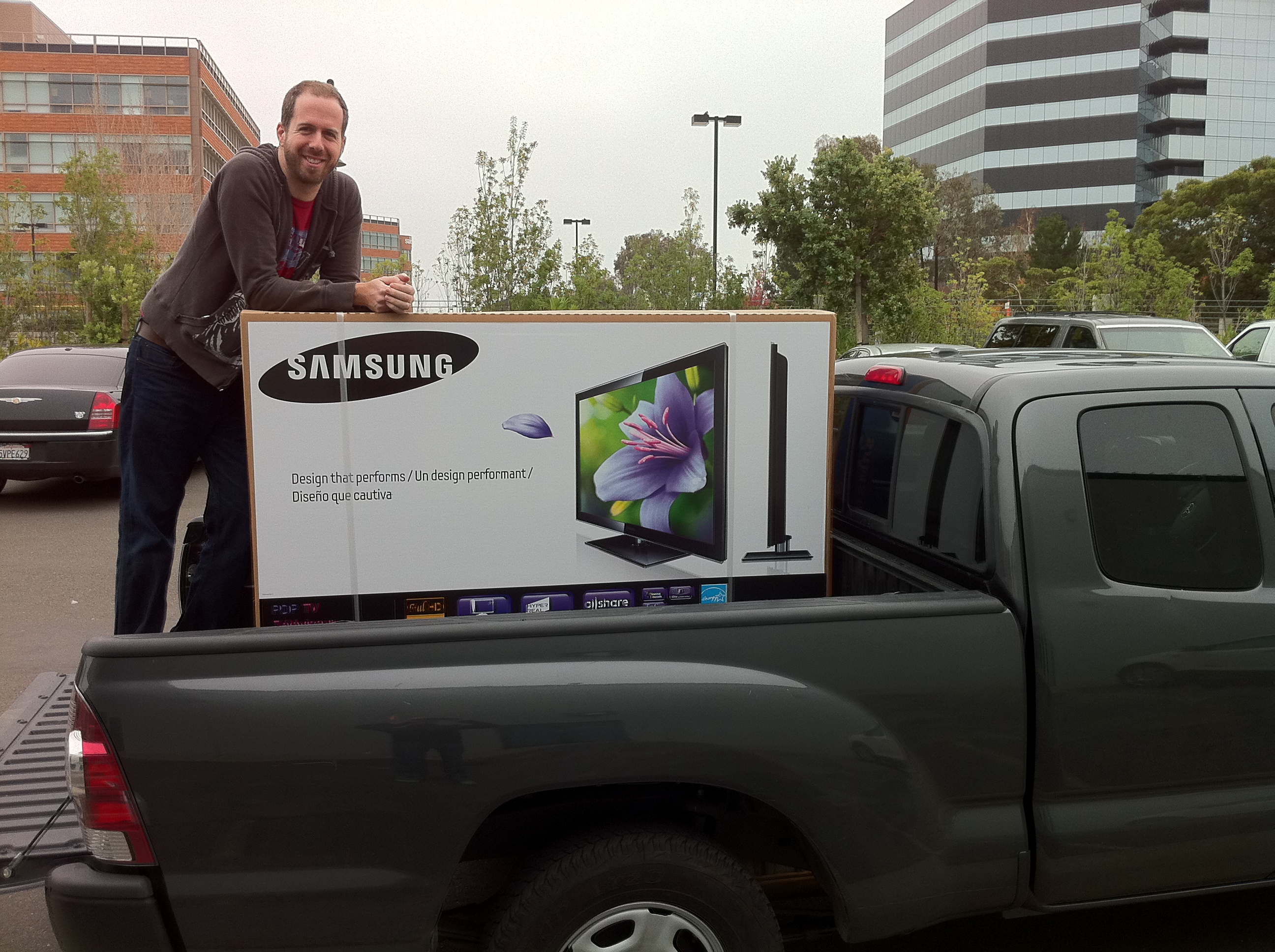
I'm on a Truck. With a TV.

Buying a new TV:  I came to the realization that my manroom, while great, was inadequately equipped with a mere 50″ screen.  So I decided to go big (then go home).  Spent a long while researching options, ended up with the Samsung PN63C590, Samsung PN63C8000, and the LG 60PK950 as my top three choices.  Two of these three had 3D and Internet connectivity, the other was just a big honking 63″ screen.  I went with the big honking screen and skipped on the frills.  I realized I don’t much like the current 3D experience in theaters or homes (makes me a little nauseous), and the likelihood that I’d want to frequently watch 3D at home was pretty low.  Regarding Internet apps, I’m not really impressed with most of the available apps, and I’m not very convinced that the current platforms won’t be obsolete within 12-18 months (looks like I’m not the only one who feels that way on both topics).

In a nutshell – the TV is awesome, manroom now operating at near-100% efficiency.

Cord-Cutting: So my new TV is great, and also huge.  And there’s an interesting downside to it being huge – the gaffes of lower quality video are worse than ever.  As soon as everything was hooked up, I turned on the NHL HD channel (sports channels seem to be at the top of the quality spectrum in the HD channel lineup).  All I could see were the jaggies and other terrible aftereffects of the highly compressed video Comcast delivers to my house.  So how did I make my TV look good?  I turned on my Xbox!  I think this “faux” HD experience is something that actually could cause cord-cutting in 2011 – far more than Smart TVs will.  More on this over on the Stage Two blog.

Smart TVs:  Speaking about Smart TVs (the continuity in this post would astound my high school English teacher), I read an article on “What Smart TVs need to Succeed” with the highlights being: Unlimited Content Access, Extensive Use of Apps, and Immersive Experience.  I think I understand that perspective, but I also think it is missing the boat.  People tend to compare Smart TVs to Smart Phones.  If you recall, the first several *years* of smart phones were some truly terrible products.  But when it comes to phones, that’s “ok” because they are low cost (relative to TVs) and owners expected to replace them in fairly short cycles.  TVs, on the other hand, are expensive and consumers tend to replace infrequently (unless of course they have awesome manrooms that warrant the upgrade).  A generation of underwhelming Smart TVs will likely put a damper on the entire industry.  What Smart TVs really need to succeed is great, intuitive, television-like user experiences.  And I will be blunt by saying none of them do it right now.  And I don’t see this changing for at least the first half of 2011.  Which is why we’ve got a new thing cooking in Stage Two’s labs, all about making a really good TV user experience.  Will show ya next year.

Del.icio.us shutdown:  Just like everyone else in the Web 2.0 era,  I used Delicious for about 45 minutes back in the mid 2000′s, then stopped.  I know there’s still a solid fan base, and a lot more people found it a lot more useful than I did, but Yahoo’s let it languish since about 6 months after purchase.  Other than buying a better domain for it, it doesn’t seem like the company cared about it one bit.  And now they are shutting it down.  I think this is pretty terrible, and as I tweeted… “irony of delicious shut-down? bartz could’ve made only $46.2M last year and still had a full-time TEAM on *improving* the product…”  Shame on them.  I’m sure there’s some great spreadsheet somewhere that shows why its the smart business decision, but the audacity of the entire Yahoo situation is just plain infuriating.  Highly recommended reading: Thomas Hawk’s letter to Carol Bartz.

Online privacy:  The entire concept of privacy is up for grabs these days.  Some feel it’s dead, some feel it must be protected at all costs.  I sit closer to the “protect my privacy” camp, and as a result am encouraged to see the government taking some form of action.  Unfortunately, I don’t know how much actual good it will do, but since the industry isn’t self-regulating, I have to assume it can’t make things too much worse.  I remain convinced that the mega-millionaires who run the companies who effectively control our online privacy have the incorrect moral incentives in place, especially considering they can pay their way out of the issues the rest of us face.

Microsoft To Launch Tablet at CES: Again

Tuesday, December 14th, 2010

If the definition of insanity is doing the same thing over and over again and expecting different results, then Microsoft needs a straitjacket.

How many times has Microsoft tried a tablet? At least four, over the past eleven years. How many times have they failed? Four. Today the New York Times is reporting that Microsoft is taking aim at the iPad and will introduce several tablet PCs at CES next month.

People familiar with this device said it will run the Windows 7 operating system when in landscape mode, but will also have a layered interface that will appear when the keyboard is hidden and the device is held in a portrait mode.

[SNIP]

The applications will not be sold in an app store, as with the Apple iTunes model, but Microsoft will encourage software partners to host the applications on their own Web sites, which will then be highlighted in a search interface on the slate computers. It is unclear if these applications will be ready for C.E.S. as most are still in production.

Making hardware is not that hard. Almost anyone can build a tablet computer these days. Making a great tablet is very hard. I’d even wager that the team behind the iPad looks at their product and all they can see is future improvements. That said, it is clearly the best tablet we’ve got so far. It is hard to replicate the iPad’s usability. It is hard to capture intuitive and repeatable gestures. It is hard to capture Apple’s mindshare and market position.

It seems these days that Microsoft is reacting instead of leading. Their fundamental approach is “iPad is not that good and doesn’t meet the needs of business professionals.” And that plan just isn’t working out for them.

What happened to the Microsoft that invented Windows? Remember Start Me Up? What happened to the company that built Office and the Xbox? I want to root for Windows and Microsoft. I want Microsoft to deliver simple, beautiful technologies to people.

And just like I have for the past few years, I’ll be skipping Ballmer’s CES demo. Not that I don’t want to be there. It is that I feel like I have been there before. I will hope for something amazing. I would love to discover that I missed the best keynote ever. But instead, if it even mentions Microsoft one note, someone should have a straitjacket on hand just in case.

Why Trying To Destroy Online Information Is A Dumb Idea

Friday, December 3rd, 2010

Trying to put a muzzle on the internet is dumb. The nature of the web encourages users to create and share material easily and information wants to be free.

As we should have learned from the Streisand Effect, attempting to remove online information can have unintended consequences. That is, trying to delete “unwanted” websites only draws more attention to the content on said websites and makes the person attempting to stifle information look like a complete tool.

Take the recent outcry against Wikileaks. In attempting to remove the informationfrom the web, critics have only amplified the reach of the Wikileaks website. And even if the site is shut down, the information on the site can never really be destroyed.  Further, if it goes away, there’s a more-than-average probability that something else will return in its place, only less individually targetable.

Remember the end of Star Wars (the real one, not the one with the racist puppets), Obi Wan Kenobi tells Darth Vader that he can never really be defeated. If Wikileaks is struck down, it will only become more powerful than we could possibly imagine.

The recording industry and Napster serves as a classic example of what not to do online. The RIAA saw their files getting shared by music enthusiasts and immediately tried to shut down the system through legal means. The results? The RIAA did get Napster to go legit. They also then birthed distributed clones, now in the form of bit torrent sites around the world.  Only this time they are unstoppable.

What if, instead of the world of RIAA lawsuits, underground file sharing and billion dollar iPods, there was a different industry response? What if the music industry had worked with music fans to share content (for free and for profit), connect people with bands that they love and help individuals, music and technology converge in a positive, fun way? Isn’t that vision preferable to the world we inhabit today?

What is true for the record industry specifically is also true for the internet in general. When information appears that outrages, shocks, angers or offends you, the answer is not to destroy that information. This only leads to more websites, prolonged lawsuits and increased attention for the unwanted content.

Instead, individuals and organizations should recognize that information – once it is online – is almost impossible to erase. A better engagement strategy works with established structures of information and tries to compromise, collaborate and adapt. Do not try to forcibly take things offline.

I don’t exactly know what “should” be done with WikiLeaks.  I just know that taking it down is unquestionably part of the path to the Dark Side.

Quick Hits: Sony Remote Monstrosity, Early Revue Reviews, Android #1?, iPhone-to-TV, Congrats Foundry Group!

Wednesday, October 6th, 2010

Sony Remote Monstrosity
Engadget got a sneak peak of the Sony/Google TV remote control.  It’s either hideous, or simply an internal prototype used for them to develop with.  I wish it was the latter, but bet it’s the former.  Over on the Stage Two blog (I’ve been doing a lot more blogging there recently, it’s not just us pushing client work, give it a read!) I go into specifics of what’s wrong with it, and also tangible steps on how to improve it.

Early Revue Reviews
Saw a quick hit on CrunchGear today, I’m in complete disagreement with everything they say that makes it “good”.  My highlight nitpick is their closing remark: “As we said before, the real initial value will come from the camera that Logitech is selling for video chats on the TV.”  The real value of a $299 device is that you can hook up a $149 camera to it to do video chat?  Really?  That is going to move the needle on Revues?  Hint: no way.

Elsewhere, my friend Harry calls it the Swiss Army Knife of Internet TV products.  I’d say that’s a great analogy, but follow up with my biggest concern: the TV is the one place we don’t want something like a Swiss Army Knife. See, those Knives are handy to have around in a pinch, but in every way fall short of being really useful for a long period of time.  Yes, it’s cool to have a philips head screwdriver in your back pocket when camping, but I wouldn’t put together IKEA furniture with one, that’s when you need the actual screwdriver – aka the single purpose product that works really really well.

I’m maintaining my position that Google TV 1.0 is not ready for consumer primetime, and neither the Sony nor Logitech solutions are compelling to the mainstream.  Sorry to my friends who work at those companies, but this just isn’t what it needs to be for a big win.

Android #1?
I saw one of those big flashy attention-grabbing headlines today “Android Most Popular Operating System in U.S. Among Recent Smartphone Buyers”.  Beyond my general disdain for Android (though I will freely admit the HTC Incredible running Android 2.2 is leaps and bounds ahead of my old Eris, but still has lots and lots wrong with it – for another time), I hate headlines like these.  What would be MORE interesting?  What is the popularity of Android specifically on AT&T?  That’s at least apples-to-apples comparison (pun fully intended). Of course
Android is going to hit the top spot, this is inevitable, not interesting.

Now what would be interesting?  Well, since this is arguably all about a landgrab for developers to adopt platforms, how about an analysis that talks about which platform is making the most money to developers? Until Android/Google makes the process of buying (and selling) apps easier for everyone, the money is still flowing to Cupertino.

iPhone-to-TV
The newest version of Netflix for iPhone enables watching the movies on a TV, rather than on the phone itself.  Very cool, nice novelty feature.  But when I see a phrase like “Who needs an Apple TV now?” I get reminded of how often people in the industry aren’t thinking these things through very much (no offense to the author of that particular blog post).  To be clear – a phone, even an iPhone, does not replace a TV dedicated device, now or ever.  Wrong device for the wrong purpose.

What if you need to make a phone call mid-movie?

What if your phone runs out of battery?

What if your phone drops the signal (apparently those iPhones are known to do that from time to time)?

What if you want to put the movie on, then sit 8-10′ away from the TV, and, say, pause or rewind the movie?

etc.

Congrats Foundry Group!
Just wanted to take a second to congratulate Brad, Ryan, Jason, and Seth at Foundry Group for raising their latest fund! I’ve had a long history with the guys and a lot of their investments, and since they are one of the few VCs who love the consumer gadget space, wanted to give them a little shout out here.  Keep up the great work, and keep finding the cool gadgets!

Excited About Judging pre-CES i-Stage Event!

Thursday, August 12th, 2010

It’s been official since a tweet last week, but the i-stage website was updated today to reveal this year’s judges/mentors, and I’m extremely excited to have my name in the list.  Other judges this year are Richard MacManus (founder of ReadWriteWeb) and Frank Gruber (founder of TECH Cocktail), and previous judges have included Blake Krikorian (my boss and mentor at Sling Media, currently living mostly off the grid), Ryan Block (founder of GDGT, former editor-in-chief at Engadget), Natali Del Conte (CNET), Ross Levinsohn (Fuse Capital), Jeff Pulver (involved in pretty much everything), and more!  Needless to say, I’m honored to have my name in this list of esteemed technologists!

This is neither my first foray with i-stage nor first judging with CES.  Last year I was a judge for the prestigious Innovations awards.  Two years ago I was working with team Boxee when they went to, and subsequently won, the inaugural i-stage event!  This plus the three “best of CES” awards I’ve been involved in, and I’d say I’m quite excited about being on the other side of things this year!

We haven’t seen this year’s list of contestants (still two days to enter), but I’m excited to see what’s up-and-coming in gadget land (especially since I like to think I’m already involved with most of the new stuff – so this makes it even more intriguing).  I’ll put together some thoughts and recommendations on what contestants should (and should not) do to increase their odds at winning (and while cash is nice (kidding!!!!), I’m more interested in impressive technology and great product experiences).

Who’s going to solve the mega photo library problem?

Wednesday, July 28th, 2010

Despite adopting digital cameras in the late 90′s, I managed to lose my pre-2003 library somewhere along the way (hence my quintuple backups, including online and offsite copies). That said, I have over 15,000 digital pictures in my iPhoto library, and average 300 or so new images per month, not to mention the videos stored along side them. At this point, the library is so large it’s right on the edge of being completely unusable.

Scrolling through images? Useless. Manually creating albums? If I don’t do it as I sync the camera, it never happens. Events? Nearly worthless. Browsing through photos on my Xbox? Actually impossible. About all I know is I DO have safe backups, and if I’m willing to scroll enough, the photos are all there to view, print, etc. Which I basically never do.

Further, the actual size of my library is now so big (125gb) I had to move it to a USB drive. And as cameras continue to improve, or as people adopt more DSLRs and video recording devices, collection sizes will grow out of manageable sizes.

And this is a problem that actually notably worsens every month.

So what’s to be done about it? Here’s what I propose:

1) Photo management tools must become capable of comprehending multiple file storage locations.
A user should be able to divvy up their collection across local, USB, and networked drives, and have clear comprehension of how to manage this. Maybe I keep my “recent” and “favorites” on the laptop, the “last year” on a USBdrive, and all the rest on a networked drive (or secondary USB drive, or both). Further, this must be implemented in such a way that a user can easily figure out where stuff is, in a non-technical fashion.

2) Photo tools must have independent, intelligent, automatic, redundant backup services
There are no files I have that are more important to me than my pictures. In fact, my photos become *more* important over time, and as the collections grow, *more* likely to have problems (data corruption, loss, etc). Backup should not be an afterthought, it should be a required element of the environment – plus it’s a great upsell opportunity for virtually all involved providers. On a related note, the management tools should effectively inventory my entire collection, and warn me if any given subset is at risk.

3) The introduction of new photo organization paradigms
While all the apps do effectively decent jobs at creating events, albums, albums within albums, folders, timelines, tags, favorites, and more, it’s simply not enough.  Which makes sense, given that in all reality, this is a problem the photo world hasn’t really faced before for typical users.  In the past, the only people with tens of thousands of photos were professional photographers, who never really need to manage or even access all of them simultaneously.  The digital photo management world is only slightly more powerful than print photo albums and shoeboxes full of pictures.  We need new concepts in how we’ll organize pictures (and incidentally, making users tag them, is not the answer).  I’m personally still noodling on the concept, and have yet to come up with something – but I trust there are better data/knowledge management folks out there than myself.

4) Video must become a side-by-side feature to photo management
Whether it’s video capture built into a digital camera or a standalone device like a Flip, users are increasingly creating video libraries.  And much like our photo libraries, the files are disorganized, not easily searchable, and have no strong mechanisms for organization beyond simple file/folder/date concepts.   Since there’s a high likelihood of people creating even more videos in the future than they do today, this problem must be addressed in parallel to the photo one.

There it is, my “manifesto” for personal photo management software.  Looking forward to seeing the future of iPhoto, Picasa, and other mainstream tools for what is clearly an impending mainstream problem!

GIVING NOTICE: I’m reclaiming Facebook for personal use

Monday, June 14th, 2010

According to Facebook, I have over 400 friends.  According to the number of people with whom I share personal things, go out for drinks, have over for dinner, call to catch up, and otherwise consider “Friends”, that number is off by a long shot.  So I’m going to fix it, and I’ll explain why.

I consider myself quite a social, yet private person (yes, privacy matters, and is not going away anytime soon).  I speak at a good number of public events, am decently well known in the tech industry, and am generally “out there”.  But I don’t like to share my personal life with everyone, partially because I don’t think everyone cares, but mostly because I consider my life private.  I neither need nor want “the world” to know whether I go for a bike ride with my kids, have a date night with the wife, catch up with an old friend over a beer, or any other “regular living” activity.  But it’s deeper than that.

I firmly resent the notion that I am supposed to have to include anyone and everyone I’ve ever met into my personal life, and even if it’s considered an industry faux pas, I simply don’t care anymore.  I have plenty of vehicles for communicating anything remotely work/tech/industry related, and plan to continue to use them.  Facebook, for me, is supposed to be my personal network, not my professional one.

So here’s my new Facebook friend policy:

  • Actual Friends, not “friendly acquaintances”
  • Current Friends, not “people I kinda knew in high school”
  • Work people I go out with socially, not “someone I met at a conference and exchanged business cards”
  • etc

In the next few days, I’ll be UNfriending anyone who doesn’t make the above list.  This might sound harsh or alienating, but I like to live my life assuming everyone has enough self-esteem.  I don’t look at this as rejection, and I hope anyone who gets unfriended doesn’t think of it that way either – it’s not.  Just because I like someone and have a professional relationship with them doesn’t mean we’re Friends.

While I might be an “early rejector” I fundamentally believe I won’t be the last, and most folks will come around the conclusion that they need to separate out their personal lives from the professional. While there will be many who have some blend (I believe I’ll be in that camp),  It really never should’ve gotten so far out of hand in the first place. I hope my actions can help others who are feeling the same way, but scared of the potential backlash.

Predictions for WWDC 2010

Monday, June 7th, 2010


Watch live video from Jeremy Toeman on Justin.tv

Summarizing my video, my predictions:

New iPhone, possible OS X and/or iWork update, lots of stats, demo’s of iPhone 4.0 OS, no cheap Apple TV refresh, no iPhone on Verizon

Links I reference in the video:

More Talkey, Less Typey.

Tuesday, May 25th, 2010

I’ve blogged for almost 6 years, written over 700 posts, with countless (not really) words.  While I’m no Block, Topolsky, Scoble, Gray, or Zatz, I’ve been prolific in my own eyes.  I’ve had writing block and had moments of near vomitous levels of typing.  It’s been fun, it’s been entertaining, it’s been exhausting, and so many more things.

It’s also a lot of pressure, and the pressure is getting me weary.  I love reviewing products, but barely have the time to even use them, let alone do competent reviews.  I love chiming in on “memes”, but often find 95% of what I’m planning to say is already being written by someone else.  I hate the feeling that I’ve been negligent of blogging after even 3 days go by between posts. I’m fatigued.

So I’m trying something new: video.  Mostly short form, 2-5 minute segments is probably my goal.  I intend to remain focused on consumer electronics, gadgets, digital lifestyle, and social media as it pertains to digital lifestyle.  I intend to remain opinionated, possibly even moreso than in the past.  I intend to attempt to be entertaining, to the best of my ability.  And most importantly: I intend to have fun, and ease the “pressure” I’ve felt in recent months.

I’m using Justin.TV as my platform, here’s my channel.  I also plan to do “live interactive stuff” whenever/wherever possible, and will probably use Twitter as my mechanism to announce said stuff.  Here’s the first segment:


Watch live video from Jeremy Toeman on Justin.tv

first post from my iPad

Saturday, April 3rd, 2010

This is just a test post using the worpdress app on my brand new iPad. Big thanks to Charlie and Brian from the sf chestnut street store.

Playtime!!!