Archive for the ‘Convergence’ Category

Macrovision acquires Mediabolic for $43 Million

Wednesday, January 3rd, 2007

Mediabolic logoFor the most diligent of my readers, you may recall Mediabolic, the company I cofounded back in 1999 with Dan Putterman and Brad Dietrich (the CEO and CTO, respectively).   It’s a very exciting day as they were just acquired by Macrovision for $43 million US (official press release, SVSJ mention, reuters, SJ Merc, or find more at Google News).  Congratulations to everyone at Mediabolic!

Macrovision logoFor more details on the acquisition, you can read this letter (PDF format) from the CEOs of both companies.  This is the kind of deal that seems to make a lot of sense for both parties.  Macrovision already has technology inside many consumer electronics devices (for example, all VCRs and DVD players).  Mediabolic has a suite of digital home technologies (more about this topic at WSJ today) that are clearly a part of the future of consumer electronics.  Win-win.

I guess this means today was the day I became a serial entrepreneur!  Just kidding, I actually don’t like that term at all, but it sure does feel great to see a company that I cofounded have a nice exit.  It’s not exactly a “life-changing event” but it is certainly a great event nonetheless!

I’ll put up a little photolog from the 5 years I was there later today to share a few memories.

Video entertainment options are all over the place

Friday, December 1st, 2006

Cinemanow and Movielink made the first huge strides in Internet-delivery of movies with their offerings several years ago, albeit not to much success.  In the past 2 years we’ve seen things move in leaps and bounds. 

HD playback controls GUIHere is my list of some of the most prevalent/important things going on right now:

  • Multi-tuner high definition DVRs are commonly available.  DVRs (HD and SD) are in about 15-20 million homes in the US today.  Timeshifting is no fad.
  • Sling Media sold over 100K Slingboxes in the first year, and now have 3 different models on the market and are in 9 countries.  Placeshifting is the new black.
  • Over 40 million HDTV sets are expected to be sold in the US by the end of the year (cumulative).  HDTV is important.
  • IPTV set-top boxes (like a cable box, but hooked up to your DSL) are in millions of homes worldwide.  It might not be a slam-dunk in the US, but many people are watching TV streaming over the Internet.
  • YouTube.  100 million videos a day.  I don’t care if it’s long-tail or short-tail or rat-tail.  I don’t care if it’s user-generated content or all clips from SNL and the Daily Show.  People are comfortable watching video on Web sites, regardless of quality.
  • Moviebeam (love the concept, but the movie selection is so lackluster these days - I’ll post more soon), Applie’s iTV, Akimbo, SAT+GO, ITVN, Xbox Movie Downloads, and a slew of other companies have boxes, products, or services that are all providing alternatives to the traditional cable/satellite TV offerings.  I don’t know how any of these options will fare, but they all seem to either be very niche-y or not compelling.  But there’s a lot more to come. I have seen the future, and I can’t name the company, but it’s coming next year, and it’s going to rock. 
  • Wal-mart’s online DVD offering (details here) sounds completely off the mark.  Jonas wrote a good piece about it, and I think it’s simply an offering with no market appeal.  If I buy the DVD, why do I need a download?  If I download it, why do I need a DVD?  Greed begetting greed.
  • Regal Entertainment is giving moviegoers a “panic button” in case they see someone on a cell phone and are unable to confront them directly.  That’s just weird.
  • Entrance to SNL studioSaturday Night Live is debating allowing live viewing of rehearsals online.  There’s a near little coincidence, as I personally attribute ALL the success of YouTube as originating with the spread of the “Lazy Sunday” clip from SNL last season (which they, at the time, vehemently protested).
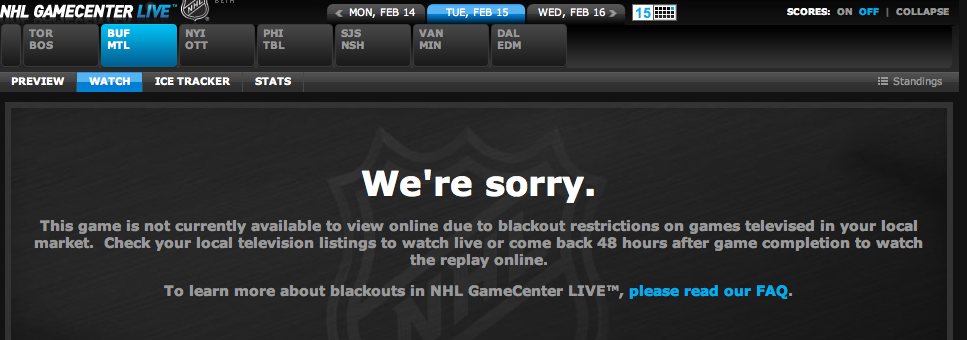
  • The NFL is looking into streaming live games online, and the NHL has some archives online (which is about as much as we’re gonna get, since Bettman doesn’t really care about the fans anyway).
  • Mobile mobile mobile.

Phew, I’m exhausted.  Did I miss anything?

Did DVRs kill the watercooler chat?

Monday, November 27th, 2006

I received my first TiVo back in 1999.  It was a 14-hour unit, made by Philips.  It changed my life.  Now I don’t even mean that in that lighthearted way - it really did change my life.  Prior to owning a TiVo I watched about 2 hours of TV a week, total. Since then, my hours have climbed to a staggering 10-15 hours per week! This is still significantly lower than the 4 hours per day of the average 2-person US household (unbelievable, ain’t it?  it climbs to 8 per day when you include all US homes!), but it’s much higher than I’d really like.  I’d blame it on Heroes, but there’s enough other stuff I watch that I have to accept responsibility for my actions.

In the early 2000’s I was still a (very) early adopter of the DVR (digital video recorder, the ‘generic’ category for what a TiVo is), always preaching its virtues to friends, colleagues, and strangers on the bus.  I remember many times when someone would start talking about a TV show and I’d have to just walk away, not wanting to hear the details for a show I hadn’t yet watched.  Worse yet, during the 2003 playoffs (hockey, of course), not one, but two games’ endings were spoiled by eager relatives calling while I was still an hour or two behind on the game.  In each incident, I’d always exclaim “haven’t seen it yet - don’t say anything!!!” and then proceed to explain the DVR.

TiVo HeadquartersNowadays, TiVos are fairly well-known in the mainstream (if you are reading this and thinking to yourself “what’s he talking about, everyone has a DVR!” you are very out of touch with the masses.  DVRs are in roughly 1 in 5 or 1 in 6 of US households, that’s it.) and you see references in TV shows and movies (and even Sprite commercials).  My Mom has a TiVo (she calls it Mister TiVo), my wife uses it, my in-laws have a DVR, my Dad doesn’t have one but knows all about it, etc.  In fact, timeshifting (using your DVR) is so prevalent, it’s being tracked by Nielsen - who recently reported that DVRs are actually boosting show ratings.

Recently, however, I’ve noticed that there’s a lot less chatting about the shows themselves.  While some are musing that TV viewership is down (the stats simply disprove this theory), others think that watching behaviors are changing.  I agree more with the latter than the former.  I believe the combination of timeshifting, TV shows on DVD, and online video is causing more of a social impact than a viewership one.

Today, when you watch a show and start talking about it, you hear responses that range from “I’ve got it in my Netflix queue” to “I haven’t watched it yet, it’s on my DVR” to “I’ll download it from iTunes tonight” and more.  People seem a lot more prone to saving entire seasons for future viewing, so you can’t talk about Entourage when your friends are waiting for it to arrive from Amazon.  Heck, I don’t even read many pop culture blogs or Web sites, for fear they’ll have divulged events from this week’s Heroes, which I just didn’t get around to watching.

I don’t agree at all that people are watching less television.  I think they may watch it with less enthusiasm than they once did.  I think they watch it with more distractions than they once did.  They watch it at different times (and places) than in the past.  They watch it on different devices. 

My feeling is that social culture is changing to de-emphasize an episode of a show as something worth talking about.  I haven’t quite figured out what’s filling that void, just as long as nobody ruins another show for me.

Europeans can now watch Slingbox on their mobiles

Thursday, November 16th, 2006

Stickered PhonesWhen it comes to mobile technology, it seems that major carriers and phone manufacturers around the world have a common mantra: “they do it in Japan and Korea, therefore …”  The statement applies when trying to convince other industry players that a given service/feature will have huge adoption rates in the US or other countries.  The phrases sound like this: “The Japanese play 3 hours of video games a day on their handsets, and spend $1023 per month for social networking services and content, so we need to bring this to the US as soon as possible!”  For the most part, it’s a lot of malarky (is that really a word?). Why?  Well, if let’s say you have one country/culture in which 2-4 hours per day of train-based travel is the norm. And you have another one in which the average commute is done by car and is under an hour.  Sounds like you don’t have much of a match, doesn’t it?  So a few years back when the discussions of mobile TV first started blossoming in the US, I was personally a bit of a skeptic.  And then I helped design and build SlingPlayer Mobile, and I saw the light.

I’ve used SPM (as we were known to call it) to kill time on the tarmac.  I’ve programmed my DVR from the long lines at Starbucks.  I even watched some of the NHL Playoffs last year on my commutes home (yes, my wife drove, I’m not that bad).  Funny thing is, I was once quoted as saying “Nobody’s going to watch the entire Super Bowl on a cell phone.“  And while I stand by that statement, for this year’s game I did have my PPC6700 showing the game live in the bathroom so nobody would have to miss a minute’s action (go Stillers!).

As was announced today, Europeans (starting in the UK, spreading outwards in 2006) can soon have the same joy.  Instead of Heroes they’ll be watching Eastenders.  Instead of the Superbowl, they’ll do the World Cup (in a few years).  Instead of The Office, they’ll do.. oh. well… The Office.  Hmm.

In an interesting twist, Sling Media launched SlingPlayer Mobile in Europe with a mobile operator, 3.  Now 3 is going for some kind of quintuple or octuple-play by bundling a few other options and services with their new X-Series offering (live Webcast tomorrow), and you can read more details about it over at the SlingCommunity site (or Unwired or Gadgetell) .  Seems like an interesting play, but I’ve gotten spoiled I guess, since I’m a Windows Mobile user, and the extra services are all available to me on the 6700 I use. 

Slingplayer on Nokia N73The other interesting element here is this is the first time the Slingbox is viewable from a non-Windows Mobile device.  The handsets for the launch are the Nokia N73 and the Sony Ericsson W950i.  I think it’ll be interesting to see the performance comparisons as more and more users adopt the service.

Good thing the Internet rumor mill didn’t go too far after Blake mentioned something about a mobile carrier at last week’s Web 2.0 show.  Check out speculation at Unwired, MocoNews, and Engadget.  It doesn’t take too many hops in the blogosphere to go from “idle comment” to “solid fact” these days.  Either way, congrats to Sling and 3 for putting together a great relationship that brings smart value-added services to their customer bases.

Akihabara Subway stopWell, time for me to get back to playing 3D interactive multiplayer video games on my mobile phone with built-in GPS, DVR, MP3, and waffle-making capabilities.  I’ve got a long way to go to get to Akihabara.

Gartenberg’s tips to build better music phones

Thursday, November 9th, 2006

For those of you who don’t know Michael Gartenberg, he covers the consumer electronics space (and a whole lot more, sorry if I’ve oversimplified Michael) for Jupiter.  More importantly, he gets it.  Lots of people in this industry are good at marketing, or good at engineering, or good at products.  Not all of them get it when it comes to making outstanding products that consumers love.  Read his “three laws of consumer electronics” before you go on.

I know Michael gets the chance to play with most new/unreleased phones (yes, even before me!), and I have a hunch he was recently trying out some new “music phone” and had a lousy experience.  Probably one of those cases where the company pitched him on this unbelievable sound quality, “replace your iPod”, etc etc.  And it didn’t.  At all. And if I know Michael, it got him a little riled up.  Riled up enough to write a blog post on “how to make a music phone good enough to use.”

While I agree with all his sentiments, the one that struck me the most was #1: real headphone jacks.  Unless Shure or Bose starts building wireless headsets with the exact same sound quality of their current lineup, there is no way mass consumers will drop their Nanos. 

I’m going to add a few thoughts of my own to his list:

  • Integrated music.  All my MP3s/WMAs should also be ringtones, alarms, etc. 
  • Simple album art. This is a “frilly” feature, but if I had a flip phone with top-panel playback control buttons and the outer LCD screen showed the album art, it would nicely round out the experience.  Remember: the goal is to make a great experience, not one that is worse than the Shuffle!
  • Easy USB synch.  Michael mentions WMP and iTunes, I’d probably add that it should also appear to Windows as USB mass storage.  Furthermore, the USB part must be standard mini-USB, not a proprietary connector (getting that, Moto?)
  • Smart power management. Give me plenty of notice before I run out of juice while listening to music.  Put in an option that auto-stops music playback with a certain amount of talk time left.
  • Internet radio services. Whether it’s Pandora, Last.FM, Rhapsody, or anything else, since it’s pretty likely this new phone has 3G support, give it some Internet radio access as well.

The key thing about both mine and Michael’s tips is this: none of them require significant engineering work by the manufacturers.  That’s right, you could make a Chocolate 2.0 without a major redesign.  In the meantime, I’ll stick with the chocolate I love right now.

My So-Called Digital Life

Sunday, October 15th, 2006

Javits CenterFinally!  I’ve wanted to use that subject line since I started the blog (yeah, I know others have used it too, but I discovered that after the fact)!  Well, I made it to the Digital Life show in New York City this week, took a few pics, and here’s the report…

The show opened on Thursday, and even before the doors opened, a huge line built for people who really wanted to get in.  This topic will come up a few times, but I think a lot of industry people miss the fact that this is an Waiting in line to get in...exciting show for consumers. Quite a few of my colleagues mentioned to me they didn’t see anything new, or there wasn’t much exciting gadgetry on display, but they forget that the average person out there does not see nearly the same stuff people like me get to see.  Show someone an HTC Excalibur (T-Mobile Dash) and they typically ask what is that???  I’ve read about it for months, and started using one weeks ago.  That’s what makes Digital Life fun - you get to see consumers’ reactions to the same technology that’s become almost mundane for us industry types.

That said, I personally wasn’t over-the-top excited as Barry Myers (the big brains behind the show) wished Sonic the Hedgehog a “Happy 15th Birthday” but a lot of the kids around sure got a kick out of it.  Sonic’s aging well, by the way, doesn’t look a day over 12.

 Barry Myers wishing Sonic a happy 15th birthday Sonic at 15

Video game tournaments aboundThe show was large (not CEDIA-large, but large enough), about 2/3 of the floor was dedicated to booths, the other 1/3 for gaming tournaments. Looked like the kids were really enjoying the gaming, again my assumption is that this was one of the first times most people actually got to play Xbox 360 in high-def (well, other than those in debt of course) or see the PS3 in person.  I even saw an area for “amateur” gaming, but judging by my ridiculously poor performance in Halo 2 against my 11-year-old cousin, I ran for the hills.

DigitalLife show floor DigitalLife show floor Boost Mobile lounge DDR Gamers!

Toshiba boothMany larger companies had booths, including Intel, Microsoft, HP, Alienware, Toshiba, Best Buy, etc.  It’s interesting to watch these companies try to learn and react to Digital Life in their attempts to build the right booths.  Toshiba’s booth looked like the same thing they use for CES, with the addition of a “Deal or No Deal” game (called “Mobile or No Mobile”), and Intel’s booth was all about futuristic tech.  AMD had The Quadfather (ugh - come on AMD, we like you and root for you, but nobody wants puns!), and HP had some medley of printers, displays, and pink stuff. I think Microsoft did a great job at showing off the two things the average show attendee was likely most interested in: XBox and Vista.  Sure they had some other demos incorporated as well, but the messaging was clearly consumer-driven.  Good job there.

AMD: The Quadfather U3 booth - Got Cash? EtchAMac EtchAMac Alienware Booth Namco booth Mr and Mrs Pac-man Mobile Super Pac-Man PlayStation 3 demos Jason Mewes at AlienwareGyration booth

Some of my booth/visit highlights:

  • WowWee boothWowWee (the makers of the Robosapien product line) had a simple booth showing the robots in all their AI glory.  I really like this company, and am looking forward to seeing how they expand their product line next year. 
  • PC-BOT from White Box RoboticsWhite Box Robotics was located in the Ziff-Davis “digital lounge” where they were showing their $5000 “PC-BOT.”  My friend Steven Jones (from TechLore/Capable) thinks it’s a wonderful idea, but I’m mixed.  There’s clearly no consumer application here, so we’ve got to look at it as an industrial device.  I just don’t see why I need a “robot” that is really a computer on wheels with some sensors when I can diversify that into one computer (or even more than one) and distributed sensors and networked cameras.  With the “robot” approach, I have a very expensive thing to fix when it breaks, when it’s diversified I can cheaply and easily replace broken modules.  But maybe I’m not seeing the bigger picture here, any comments on this from the peeps out there?
  • Waterproof UT Starcom phoneUT Starcom was, unfortunately, not showing the SMT5800, but they did have this waterproof cell phone instead.  Meh.  I guess it’s good for all those people who keep dropping their phones in the toilet, or maybe my friend Ben who thinks his phone is a good baby chew toy…
  • Slappa DJ CD caseSlappa showed all their awesome CD/DVD cases and laptop bags.  I really like this company and think they make some of the best products in both categories.  Got a chance to talk to them, nice people.  Check out their latest entry, a CD case specifically designed for DJ’s (not 100% sure if that link is right).  Want to know why it’s smart/cool?  They worked with DJ’s to design it.  It’s super easy to design products in a vacuum (Sony Network Walkman, hello?), and I respect the smart companies who understand their customers and target markets.
  • Mio DigiWalkerMio Technology showed a few of their “Digital Walkers” - GPS systems with a few extra frills.  I like the user interface and the well-done integration with Windows Mobile, but (as I mentioned to their reps), I really want to see them throw the whole phone integration in place.  Even as an unlocked GPRS phone, they could get a lot of traction in an HTC/Imate-like approach to the world.  Keep an eye on em (although since I still haven’t played with one, my Garmin Nuvi 350 is still my personal pick).

Sony ReaderMy personal “best in show” pick absolutely goes to the Sony Reader product.  Now I’m not saying to rush out and buy one yet, as I haven’t used it personally, but it is just soooo pretty.  Their user interface is a bit clunky (which, being a Sony product, might be a little redundant), and the buttons don’t feel right, but the size and screen are otherwise perfect.  It’s light-weight enough to hold comfortably, but I would love to see them add a simple strap on the back to easily keep it in your hand (would be very helpful for the people I know who fall asleep while reading).  Most important is the screen - it looks like paper.  It might be a generation or two until the product really works as it should (tbd), but it’s an amazing thing to see.

Sony Reader  Sony Reader Sony Reader

Michael Gartenberg being interviewedMy last batch of pictures are all a little more personal… First, Michael Gartenberg gets interviewed where he is most likely prognosticating on gadgets, gizmos, and whatnots.  I didn’t see the taping, but I’ve got to assume he received no fewer than 7 calls on his 3 phones during the 5 minute shoot.

Digeo box and Slingbox PRO on demoNext there were a couple of Slingbox demos.  First, we had the Slingbox PRO on display in the ZD digital lounge (hooked up to a new Digeo Moxi box).  Also I spent some time with Matt Whitlock (from SlingCommunity and TechLore) who interviewed Brian Jaquet (Sling Media’s Director of PR) about the upcoming SlingPlayer Mac software.

Matt Whitlock interviewing Brian Jaquet Brian Jaquet showing SlingPlayer Mac

Dave Zatz and his groupiesI also got to walk around with Dave Zatz for a bit (read his moblog of the show here). Highlight moment was goign to the iBloks booth, where we watched a couple of go-go dancers shaking their stuff.  I perched in front of the booth while Mr. Z walked into the middle, and we snapped a fantastic pic of the dancers trying to figure out what the heck he was doing there.  CLASSIC!

Toeman Sr. and McGruff the Crime DogLastly, my Dad happened to be in New York at the same time, so I had him come by the show for an hour or so and we walked the floor together.  This was especially fun for me, as I rarely get the opportunity to really show him anything about my industry.  Sure he knows what a Slingbox is, and he gets that a lot is afoot in the digital media space, but this was his first tech trade show.  He was genuinely interested in walking around and seeing new stuff, and that experience was really insightful for me to watch.

Javits Center at sunsetI’ll reiterate what I said at the beginning of this post:  DigitalLife is a great consumer show.  If you are an industry guy or gal, it’s not going to show you new tech.  Instead, you’ll see your customers’ reactions to the products you build.  And that, my dear readers, is truly priceless.

iRiver Clix review: sure it clicks, but does it click?

Sunday, September 3rd, 2006

Clix startup screenNo there isn’t a typo in the headline for my review of the 2GB iRiver Clix, another portable media player trying to take a small bite out of the amazingly large pie that is otherwise known as Apple’s MP3 player market. I must say, whenever I get a new device to try out, I start off with some kind of desperate hope that it will be good enough to at least compete with the juggernaut that is iPod.  For what I’ve seen to date, the Clix is close.

For a quick definition: the iRiver Clix is either a “portable media player” or an MP3 player capable of showing photos and videos (take your pick for which you prefer).  It’s small (fits in the palm of your hand) and has a gorgeous screen. The most novel thing about the Clix is the fact that the screen itself is “clickable” - if you want to navigate up a list of MP3s, you actually click on the upper screen region.  Sean Alexander has a video of using the Clix that really shows off the usage, graphical user interface (GUI), buttons, etc.  One of my favorite ‘little touches’ of the Clix is the ‘hold’ button actually prevents the directional screen from being clickable while locked.  Excellent touch.

iRiver Clix carrying caseiRiver Clix carrying caseiRiver Clix carrying case

Pictured above is the Clix in its standard carrying case, which is small enough to easily fit in any pocket.  I really like the size and feel of the Clix, and also like the weight.  In fact, it has the feel as if they intentionally made the device heavier than is needed, which I think is a good thing.  I find the iPod way too heavy, and the Nano is way too light - the Clix is about the right size and right weight to do the job.

iRiver Clix packagingiRiver did take a few packaging cues from Apple.  When you open the main box, every little piece inside comes in its own smaller box.  Then, inside each box is an individually wrapped cable.  While everything is recyclable, I’d really like to see a few companies take an environmentally conscious step ahead of the design curve and have a whole lot less plastic and paper inside.

iRiver Clix package contentsiRiver Clix package contentsiRiver Clix package contents

Clix synchronizing with PCThe Clix did work extremely well “out of the box” and the first time I connected it to my PC, it immediately started charging and Windows recognized it as a “Clix” (even with a cute little icon).  In fact, there wasn’t any plug & pray at all, it really worked exactly as expected.  I had already upgraded to Windows Media Player 11 (now in second beta), so as soon as I selected to synchronize files, WMP appeared, all set to transfer media files.

Moving music and photos onto the Clix was quite easy.  Drag and drop inside Windows Media Player, or for those who don’t feel like installing it (yet), you can also find your Clix as a drive inside My Computer (for the technospeak - it appears as a USB mass storage device). 

Nice little Clix icon in the Windows autoplay viewCharging Clix over USBClix synchronizing with PCClix synchronizing with PCAuto-setup over USBEmpty ClixBrowsing mediaClix synching with media collectionConverting filesClix synchronizing with PC

iriverter getting infoWhen it comes to moving video files, the Clix wasn’t nearly as graceful.  This is actually my biggest disappointment with the device and probably the only thing that prevents it from being a head-on competitor to the iPod.  The device natively supports a few video formats, which didn’t include Windows Media Video, which is a must-have for me (see the specifications for the list of formats it does support).  The company referred me to try a third-party (open source) software called iriverter.  It too, unfortunately, didn’t work.

Clix Now Playing listOnce the files were moved over, I have to say using the Clix is a mostly satisfying experience.  The GUI is very easy to use. I’ve tried handing it to multiple people tasking them to “play some music” and everyone figured it out on the first try.  In fact, it’s almost fun to use it, even when you aren’t watching/listening to media.  Without diving into too many details, the Clix media playback features are all the ones you’d want or expect, including queueing, playlists, rating, etc.

Clix Browsing Music: showing artistsClix Browsing Music: showing tracksClix graphic equalizerClix graphic equalizerClix Quick ListClix Quick ListAdding music to Now Playing queue

Browsing photos on ClixDuring the transfer, Windows Media Player automatically converted my photos into the right size (320×240) and created a folder structure on the Clix based on the photo folder hierarchy on my PC.  So “My Photos > Wedding pix” was perfectly replicated on the Clix.  This has a slight drawback in that it isn’t configurable in any way, so when I dragged in a folder deep into my My Photos directories, the entire hierarchy appeared as well.

Browsing photo folders on ClixBrowsing photo folders on ClixBrowsing photo folders on ClixClix showing a picture

Rebuilding Clix libraryIn addition to media playback, the Clix also supports text browsing, Flash games (you can browse more to download here), has an alarm clock, FM radio, and a suite of other supplemental features.  While 2GB might only hold a small portion of your media, I must say everything about using the Clix itself once media is tranferred is really a great experience.  The only other drawback I had for the product is somehow the internal database in the unit I was using got corrupted.  I actually had to do a whole ‘reformatting’ of the internal memory before I could use it again.  This was an isolated experience, and easy enough to fix, but might have caused me more pause had I bought/unlocked a lot of music on the device.

For another detailed review, check this at Gearlive, or you can go to Engadget for a series of reviews.  The size is right, the price is right, the product is good, the screen is great.  My only caution is if you really want the product primarily for video playback, you may have to jump through a bunch of hurdles to get your files transferred properly.  If you are looking for a really good iPod nano alternative, and your focus is more music/photos than video, I heartily recommend trying the Clix.  Plus all the cool kids over at MTV are using it.

My gadgets should learn a thing or two

Monday, July 17th, 2006

I have a lot of gadgets.  MP3 players (got an iRiver Clix to check out too!), cameras (still need a new one…), convergence products, media servers, media players, etc, etc, etc.  Not a single one of them can learn a thing from me, and I don’t understand why.  Before you get too skeptical on me, let me be clear: I am not talking about “learning” as in artificial intelligence (AI), I just want them to have a few behavioral modifications.

My first example is my new Harmony 880
Works great, about 90% of the time or so.  Every now and then it misses a command, or in some way gets ‘off’ with the living room.  The nice thing about the product is it has a Help button which basically steps you through the sequence of remote commands necessary to perform the function you are looking for.  So, if I click “Watch Moviebeam” (this is an ‘activity’ much like a macro), the Harmony turns on the Sony receiver, Syntax LCD TV, Moviebeam and my DVD player (which is wholly unnecessary, but I can’t figure out how to remove this step), switches inputs on my Sony receiver to the correct audio input, switches inputs on my Gefen 4×1 HDMI switch, and switches inputs on the TV.  Awesome.

But when I first started, it could never get the Gefen to switch right.  So I clicked Help, and followed the on-screen ‘yes/no’ options until it worked.  Eventually I went back to the Harmony setup application on my PC and found I could ’slow down’ the commands to make it more reliable (which did in fact work like a charm). 

I think it would be very easy for Logitech to add a bit of intelligence to the Harmony.  Maybe after doing the same thing 3 times the remote could say “please dock to your PC for an update”, at which it uploads the info to the PC, and the PC application can have enough smarts to say back to me: “there is a problem with your activity, let’s try to fix it.”  It doesn’t have to be smart enough to actually fix it independently (although that’d be nice too), but it should be smart enough to track little things like this.   Extra points to tivoboy who seems to agree.

My second example is my Garmin Nuvi 350 GPS unit.
Nuvi - FavoritesAgain, a device I absolutely love (full review still forthcoming, sorry, too busy working to pay the SF rent) and use all the time (as does my wife!).  The Nuvi is absolutely great at getting us around town and the Bay Area, helped me go camping, helps my wife find her delivery locations, we love it long time (and we certainly do not leave it in the car overnight).  I really like setting ‘favorite’ locations (pictured to the right), for work, for home, it’s quite handy.  In fact, its versatility at finding locations is quite impressive.

What I don’t understand about it is the inability to learn just a few things.  Remember, the Nuvi 350 can play MP3s, audio books, show pictures, find nearby ATMs (and more importantly, Dairy Queens) and even pump gas and check the oil pressure for you.  But no matter what I do, it refuses to remember the fact that I live in San Francisco.  Every single time I enter a city name, I have to type in “San F” and then select from a list. 

Nuvi - enter cityHow about, after the 5th time I make that choice, it simply auto-saves it, and then give me an option to ‘Change City’ next time?  It even has the concept of a “home address” and knows I live in SF (can’t call it San Fran or Frisco, they hate that here…  I don’t know who ‘they’ is, but I know I will get whacked if I use those terms).  I’ve got two more ‘freebies’ for Garmin as well:

  1. If I click ‘detour’ give me the option to keep that detour.  Maybe it’s a closed road, or just a really bad route.  Better yet, if I deviate from a route multiple times, ask me if that’s a better way to go!  The manuals state very clearly that the Nuvi will not guarantee the best way based on city shortcuts and everything.  I totally understand and appreciate how much work that must be.  But why won’t it pay attention to my driving and catch on after a while?
  2. When I turn on Nuvi, I always fall into one of two behaviors:  I either wait 10-30 seconds then click View Map (this implies I am already driving), or I almost instantly click Where To.  How about, after 20 seconds of inactivity, it automatically goes into View Map?

Now I know learning isn’t easy.  I know AI is ridiculously hard (although improving every year).  But even Windows has some basic learning features, and everybody likes to rant on how hard it is to use.  Office automatically adds contacts. Word adds, well, words. 

I think the gadget guys need to take a few cues and have their devices do so as well.

I’m living in perfect Harmony!

Wednesday, June 28th, 2006

Harmony vs the pile of remotesI first saw the Logitech Harmony remote back when they were a small Canadian company, demonstrating it at a trade show a couple of years ago.  Their initial demos focused on giving EPG functionality to a LCD screen on the remote, but thankfully they made a switch into offering what I will have to call the best damn remote control on Earth.  Then Logitech bought them, and 2 years later they’ve managed to not screw it up!  Is the Harmony 880 perfect?  Nope, but it’s as close as I’ve seen.

In my mess of living room devices are the following:

Harmony vs the pile of remotesI have a lot of remotes - 6 of them to be precise.  I’ve connected the video for the Moviebeam, DVD player, and DVR to the Gefen switch, which is connected to the LCD.  All audio runs directly through the Sony receiver.  Changing inputs requires 2 remotes, and then I need the actual device remote.  As of about 2 hours ago, I only need one remote now, the Harmony 880.

The Harmony is shipped in Logitech’s signature green packaging (with a nice bubble exposure to show the actual unit), although I almost lost a finger trying to open the thing.  it comes with a docking station, a rechargable battery, a USB cable, a quick start guide, and the setup software.  After the initial charge was complete, I moved right into setup.

Harmony packagingHarmony packagingHarmony in cradleHarmony in cradleHarmony vs the pile of remotesHarmony vs the pile of remotes

Harmony vs the pile of remotesFirst step was to download and install the Harmony software (easy, but I’d rather not have had to register just to do it).  A few minutes later I followed the very intuitive step-by-step setup wizard, and within about 10 minutes everything other than the Gefen switch and Moviebeam were in my devices list.  You may be wondering why I was using my laptop to configure my remote control, but trust me when I say it’s worth it.  I’ve tried many many different programmable remotes over the years, and they are all awful (yes, especially including the horrific Pronto from Philips).  Whether its entering bizarre 4-digit codes or worse yet, pointing two remotes at each other and pushing buttons in odd sequences to ‘learn’ functions, the experience is always bad.  Enter Harmony and the PC.

Harmony vs the pile of remotesIn the PC setup wizard, you simply identify the devices you own by category: TV, DVD player, DVR, etc.  All you need to know is the make and model, they have it in their database (although I’ll explain later what happens if they don’t - but don’t worry, they do).  The software then uses USB to automatically program the appropriate infrared signals into the Harmony for you.  Done.  Game over!

Harmony GUIAnd that’s when Harmony starts getting cool.  They also have the concept of ‘activities’.  An activity is “watch TV”.  When I push the “watch TV activity” on the screen of the remote, it automatically performs a macro (a series of commands) to turn on my TV (if its off), switch it to the right input, turn on my Sony receiver, switch it to the right input, and turn on my cable box.  Automatically.  Best part is this: at the end of the macro, the remote asks you if it worked properly, and if it doesn’t, it helps you get it working right!  The on-screen instructions take you question by question to identify the problem (which can happen if you don’t leave the remote pointed in the right direction long enough, something I did a few times while getting used to it).  The screens below reflect the key steps in an activity:

Harmony GUIHarmony GUIHarmony GUIHarmony GUIHarmony GUI

Harmony vs the pile of remotesAlso nice in the system is the ability to rename devices, create channel shortcuts, and have discrete volume control (when I push volume up or mute, it affects the Sony receiver, not the Comcast cable box).  Altogether a great experience.

Harmony GUIHarmony GUIHarmony GUIHarmony GUI

With all of the glowing remarks above, I will say it’s not without it’s faults.  While I didn’t have the same problems as Steven did, I found the PC software has a lot of clunkiness to it.  When setting up the ‘activity’ to control Moviebeam, for example, I couldn’t get it to accept the concept that my Samsung DVD player doesn’t need to do anything for Moviebeam to work (I did eventually find a manual override, but it was buried deep within the user interface).  Also, integrating the Gefen 4×1 HDMI switch was much harder work than it should have been (not due to Gefen, but because Harmony doesn’t have the concept of separate audio and video switching).  Finally, the software requires a lot more confirmations and clicking ‘next’ a lot than I think is really needed - I would like to see an ‘advanced users’ version that gives you more direct control over the system (obviously this should be an optional mode, but it should be there somewhere).

There are also a few snags in the physical design of the 880.  For example, the playback controls are not distinct in shape, size, or layout, so until you learn that ‘play’ is the upper right button, you’ll never go there instinctively (but the backlight ‘glow’ effect of the remote almost makes up for this).  Also the volume and channel change buttons are a little tricky to get comfortable with.  Finally, there’s no ‘cancel’ button to exit out of the help or other interactive screens.

Harmony vs the pile of remotesBut these complaints are really just minor nuisances.  If you own 3 or more living room gadgets, grab a Harmony.  Think I’m the only one who likes it?  Check out Bombippy, Keith, and DigitalGrabber for some other reviews (nope, don’t know any of em).  Without any further hesitation, I’m declaring the Logitech Harmony 880 absolutely LD Approved!

LD Approved

Redmond & Robots

Thursday, June 22nd, 2006

Okay, picture this… it’s 2016 and your Honda XT3 SE Personal Robotic Assistant (I’m officially staking claim to this futuristic term - minus the “Honda”) walks into the dining room after dinner and asks, as usual, “Is there anything else I can get for you before I clear your plate, sir?” You say “no” but the PRA continues asking, becoming increasingly belligerent. You ask, according to the manufacturer’s instructions, the standard diagnostic question - “What’s wrong?” All you get is the BFOD… the Blank Face Of Death.

Microsoft Robotics StudioIn case you haven’t caught on yet, Microsoft is getting in to the robotics business - at least the software end of it. So now my stupid joke makes sense (BSOD)! Enter Microsoft Robotics Studio, which “offers [an] end-to-end robotics development environment … for hobbyist, academic and commercial developers.” Basically it’s BOT-DOS (boy, I’m a roll - I should get kick-backs from Webster).

Trower [general manager of Microsoft's new robotics group] says Robotics Studio is intended to help the robot industry “bootstrap itself,” the same way Microsoft’s first DOS operating system provided a standard platform that other software writers were then able to use to write a host of applications, such as spreadsheets and word-processing programs, that eventually made PCs indispensable.

Trower believes that PCs and robots are converging — and that Microsoft must invest in robotics if it wants to be a player in personal computing five to ten years from now. “Your PC is getting up off the desktop and beginning to interact in the same environment where you live in new ways, using cameras and sensors and speech technology and a variety of other advanced technologies,” he says. “This is the direction that PCs are evolving.”

Microsoft showcased this programming environment at the RoboBusiness Conference and Exposition 2006 (official press release).

“Microsoft, together with the upcoming LEGO® MINDSTORMS® NXT, will help further amplify the impact of robotics,” said Søren Lund, director of LEGO MINDSTORMS at the LEGO Group. “The MINDSTORMS robotics toolset has enjoyed a strong community of users since 1998, and the launch of our next-generation platform includes many built-in features that further the community’s ability to take MINDSTORMS programming out of the box. In combination with Microsoft Robotics Studio, PC users will have a sophisticated tool that will further extend the powerful NXT hardware and software to an even wider range of developers who wish to create advanced applications for their LEGO robots.”

We’re working to get a demo of the Lego Mindstorms NXT system so I’ll follow up with a thorough review of that product and also how well it integrates with MS Robotics Studio. Stay tuned!

Moviebeam update and more thoughts

Saturday, June 17th, 2006

It’s been about 6 weeks since I first reviewed Moviebeam (add another week or so for my HD follow-up) and there are a few updates which I felt were worth sharing.

First and foremost, as Dave Zatz reported, you can pick up a unit for $49 instead of $199 by using an online coupon (enter PR49B at checkout).  If you were even borderline before, for $49 I don’t know what would stop you from picking it up.  Dave also did a video review that you can see if you are on the fence, or just want to see it in action (Ron at Techlore did a review as well).

Next, Magnolia Pictures recently announced they’d supply movies into the system (thanks HD Beat).  I’m curious to see where this goes, as I don’t think the real strength of the product is about niche programming.  Personally, I think the mainstream movies are key to building their user base right now.  And I have a little story to share as to why I think so…

My wife and I wanted to get a movie the other night, and ended up at our local, sigh, Blockbuster.  We walked around the new release section, with our autofilters to block out Martin Lawrence, Ben Stiller and Owen Wilson films (which actually only left three movies in the entire section!).  We saw movie after movie that we recall seeing ‘coming soon’ with Moviebeam, and skipped all of these, despite them being high on our want-list.  Mid-browse we decided on ’stupid comedy’ as our category, and beelined it for JIm Carrey’s remake of Dick and Jane (lousy, and Tea Leoni needs to hang up the acting for doing husky voice-over work, she’s much better at that).  Bottom line for us was: we won’t pick something up at the store if we think/know we can just watch it with the m-beam.

I watched Aeon Flux (not as horrible as I was expecting) and Glory Road (continuing to reinforce the statement that all sports movies are good, but none are better than Hoosiers) today, the first in standard definition, and the second in HD.  I could be wrong, my contacts might be fuzzy, or it might just be to the long summer days, but the picture quality looked a lot better than before!  When I spoke with one of the execs at Moviebeam last month he mentioned that the first few HD titles they had were not the best the system can do, and after watching Glory Road, it looks promising.  It’s still not quite as remarkable as the Comcast signal, but it’s much better than the last time I looked at it!  If this keeps up, I will have to go do a real side-by-side comparison in the coming months.

Now I’m just waiting for the Ethernet port to activate so I can remove the 25-foot-long phone cable running through my hallway and hook it up to my Buffalo wireless 4-port bridge (also connected to my Xbox, Sonos, and Slingbox).  I’m also really hoping that with Internet access comes new features.  First and foremost I’d like to see community features incorporated into a Web site as well as the product.  I’d like access to some Internet-based content too (maybe Akimbo-based or even Youtube). 

I believe the future of the set-top box includes a combination of broadcast services (cable or satellite), datacasting (Moviebeam or …), and Internet access.  With this combination comes the ultimate in on-demand, personalized television.  Now sprinkle it with placeshifting and DVR services, toss in a great EPG with contextual search and a good recommendation and collaborative filtering engine, and then I’m a happy happy boy. 

Other than the fact that I still won’t be able to watch any more Arrested Development, that is…

GfG Reviews Mvix MV-5000U

Tuesday, May 16th, 2006

Mvix boxThere’s a whole lotta convergence goin on these days.  A big push (one I used to spearhead while working for Mediabolic) is getting digital media from a PC to a TV set.  I for one have a few thousand digital pictures, about 100GB of ripped music (did it myself for about 700 CDs!), and some digital videos.  Products like the MV-5000U are designed to let me playback this digital media at the TV set with a handy remote control, rather than at the PC with a keyboard.  I could go on for some length about the “10-foot” experience compared to the “2-foot” experience, or “lean-forward” versus “lean-back” activities, but I think we’ve all heard enough already.  Personally, I love my Sonos for the music around the home, but it would be nice to be able to do photo slideshows on the LCD TV.

Anyhow, the Chief Gizmateer over at Gizmos for Geeks (oh that’s what he meant by GfG) had some hands-on time with the MV-5000U.  A short excerpt of his review:

What’s Groovy: The Mvix MV-5000U has a decently high grooviness factor and as my wife mentioned several times… this is “pretty cool!”

What’s Sucky: The only part of the gizmo that was frustrating was the remote control. The navigation arrow keys were small and close together and I kept hitting the down arrow key by accident while trying to hit OK. Also, the manual was quite basic, but who uses manuals anyway?

For the rest (and it’s thorough!), read more here.