Archive for the ‘Convergence’ Category

5 New Reasons Why Apple Might Not Build a TV, Yet.

Monday, August 6th, 2012

So my last time around, I was pretty “pro” on the debate of Apple building a television set device product thing. I actually was following the topic fairly heavily, and bullishly, through CES last year, when the topic just kinda sorta disappeared.  For a bit I had a hunch they had intended to launch one in the Winter of 2012, then something fell apart with it, as the rumor mill simply hasn’t been the same since.

The two reasons I surmise why they may have planned, then pulled, a set are: (1) they weren’t happy with the physical product, possibly as a direct result of LG/Samsung demoing OLED TVs at CES this year, or (2) couldn’t pull together the content/partnerships they needed to make it the success they demand.  Then again, maybe they never had a plan to do one and finally the tech media moved on to another topic.

But here I am just shy of a year since my last post, and with some new thoughts.  In no particular order…

1) Apple makes “small” stuff. Every current product they make can be easily carried out of a store.  In fact, you can almost sense it by comparing sales rates of iPhones/iPads to iMacs.  TVs are even bigger, and while Apple has magic, you just can’t shrink the physical requirements of shipping around 55″ flat panels. While they could certainly have a white glove level of service, it doesn’t “feel” Apple to me if I can’t get it in the store, and bring it home – now. Apple is amazing at satisfying the on-demand lifestyle, and a big bulky box shipped to your door isn’t quite the same.

2) Apple makes “frequently replaced” stuff. Every current consumer product Apple makes has replacement cycles under 4 years, some 1-2. TV is 7+ and I don’t see that changing.  There’s a certain point at which the inconvenience and hassle of mounting (and unmounting) big things to walls trumps the sexiness of any product.  It’s one thing to decide on a whim you’ll replace your phone or laptop, it’s another to deal with TVs and inputs.  And even if there’s a magical solution for wall-mounting and a magical solution for cable management and a magical solution for set-top boxes, game consoles, and other equipment, consumers are used to this cycle, and that’s a much much harder thing to change.

3) Apple makes “clean” stuff. Of all my Apple products, my iMac has the most potential cables to connect, most of which aren’t used, and comes with wireless peripherals. My iPad has but one.  Clean, simple, elegant – Apple.  TVs, on the other hand, must be connected to other stuff.  Unless they can actually solve A/V Receivers, Set-Top Boxes, Game Consoles, and DVD/Blu-Ray Players in a single product, this mess continues to exist.  The living room TV world is practically defined by gozintas, so unless this is a TV set just for my bedroom, or Apple can convince consumers to replace a whole lot of other boxes, it’s putting an Apple product inside a big mess.  Doesn’t feel like their style as I see it.

4) Apple makes “transformative” stuff. Smartphones before Apple, with the exception of Palm products (early days) and a few other rarities, were ugly clunky awful things that came with plastic pens. Then the iPhone came, and most smartphones are better as a result.  The iPad too, transformed the entire concept of a tablet, one so good nobody else is even realistically in the market right now (and probably won’t be for a while).  They did it before with the original iMacs.  In each case, there was an experience to transform.  But TV isn’t broken in nearly the same way – yes, there are issues, but for the most part, most consumers utterly love the way TV works today. Further, in order to transform a TV experience, Apple would need to go leaps and bounds beyond current offerings.  I’ll never count the company out on anything, but the entrenched TV ecosystem is a bigger badder monster than anyone’s taken on before.  I have a very, very hard time seeing a transformation happening here.

5) Apple makes “well-distributed” stuff.  Every Apple product is available anywhere in the US, as well as Canada and oodles of other countries.  Even when the iPhone was only on AT&T you could buy it – you might have to switch carriers, but you could buy it.  Many rumors put Apple partnering with cable companies (eg buy an Apple Television from Comcast with a 2-year contract, at a steep discount), but this limits distribution regionally in a major way.  This would force them to deal only with satellite companies, but that brings an entirely different set of hurdles.  This effectively rules out distribution partners as a deployment vehicle, which then in turn limits the product to being a “dumb set” – something that seems even less likely for the company.

I may be wrong.  Heck, it’s Apple, they know how to solve problems others can’t even begin to figure out.  Let’s also be real and notice that their little “hobby” is already the #1 Internet streamer on the market, in a single year! But something about the magic needed to make a TV might be out of reach for a little while longer here.  Seems like until OLEDs become affordable (or some other equivalent step up) and until there’s a viable MVPD with full Internet distribution, we are going to have to wait a little longer for a glowing bezel to show up in our houses.

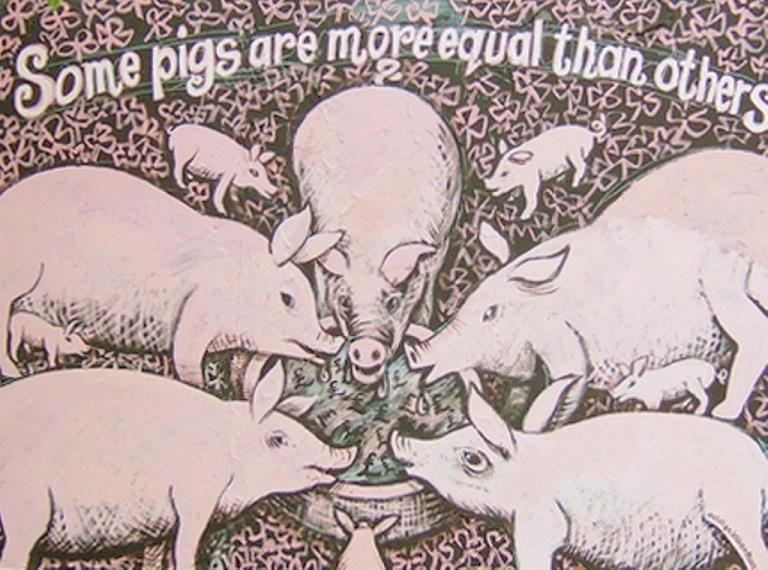
Some TV is Created More Equal Than Others

Tuesday, April 24th, 2012

As one could imagine, I end up in a lot of conversations about second screen TV apps, companion apps, social TV, etc.  Virtually every discussion takes some long varied road to get to a point where all involved agree that the only rule in building next generation TV platforms and products is this: not all TV shows are alike, and experiences must be built with this rule in mind.

Let’s start with #SocialTV – broadly defined in current terms as “people tweeting, checking in, and liking TV shows on social media platforms.”  While I’m pretty jaded in my belief that this is resoundingly uninteresting as a topic, it’s important to think of it on a per-genre basis, and in fact, a per show basis.  One could state that “dramas” for example won’t garner much social TV activity – who really cares about checking in to shows like CSI or House?  Then along comes Game of Thrones, rule broken.  Then you could use Game of Thrones data to claim people don’t tweet while watching live TV.  And along comes sports and reality shows.

When it comes to planning and thinking about how users may/will behave regarding social TV and shows, I recommend thinking about it from two perspectives: (1) live interaction and (2) cultural impact.  The personal drivers for a lot of these activities have to do with the social perspective.  People are interested in “connecting” with others, which drives the interactions (tweeting about your team, someone getting voted off the island, etc).  People are also interested in being part of the cultural zeitgeist – Game of Thrones is “in” and “cool” to tweet about, whereas CSI and House are not.

Next up are companion apps – smartphone and/or iPad apps designed for use during a TV show.  As above, the potential value creation here is entirely about the content.  Do users really want to pull out their phones and read trivia while watching an intense or immersive show like Game of Thrones or The Good Wife?  Doubtful.  Am I going to look away from a visually-rich experience such as Planet Earth? Or how about Family Guy, where half the show is visual gags?  Seems unlikely.  But during any reality show, game show, talk show, or sports? I’d guess there’s a huge opportunity here.

Same moral as above, the right companion apps keep the content in mind.  First, we really don’t need (or want) a dedicated companion experience for every single show that airs – it’s just plain unnecessary.  But regardless of that, the experiences should think about the audience and how they want to interact.  Sports is all about real-time and stats.  Cooking shows, on the other hand, don’t need a real-time experience, but yet offering recipes, how-to, pictures, etc that can be bookmarked, archived, and viewed in the future is quite handy.  Complicated plot-driven shows can offer complementary experiences that supply background or other pertinent information to help audiences keep up with whatever’s going on.

Enhanced content offerings - featurettes, behind-the-scenes, and other options that plunge the user in a further immersive landscape blah blah blah. Now, speaking as the guy who watched all 3 Lord of the Rings movies, extended cut, with director’s commentary on, there’s no question a marketplace exists for extra content.  Blooper reels.  Making-of’s.  Interviews with Cast & Crew.  The key focus again is identifying the right content for the right show and deploying it in the right place.

Do I really need a dedicated app for my iPad just to get extra content for each show I like?  Do I need to subscribe to something?  I think, fundamentally, content creators and technologists need to really spend time crafting the right offering for each individual show.  For example, having the “webisodes” of The Office available openly via Facebook each week is a great solution to enhance that offering.  But if I needed an Office app, with a new Office username and password, would it be worth the investment beyond the “Like”?  Doubtful.

Overall, the time has come for TV technologists, creators, producers, etc to work together to avoid one-size-fits-all approaches to TV experiences.  Every show, every network, every device, and every platform should be regarded as a unique opportunity to engage an audience and tell a story.  Except, of course, for reality shows about celebutantes, which should just go away. Please folks, just do the right thing here.  We can find a cure, we can make it happen.  We can do it!

How the content industry has, massively, adapted to the Internet

Thursday, March 29th, 2012

At GigaOm, a piece just ran called “It’s not about piracy, it’s about a failure to adapt” and all I can think of is how off the mark it is (and while I don’t agree with the premise, I do think it’s quite worth reading).  Here are some examples of how the industry has adapted in the past few years:

  • 5 years ago, even with high speed internet, you couldn’t legally obtain *any* hollywood content streaming over the Internet.  Today you have Netflix, Redbox, Blockbuster, Amazon, Apple, VUDU, and many others doing just that.
  • 5 years ago, your cable company only offered linear broadcasting.  Today, they offer huge selections of video on demand content, much of which is free.
  • 5 years ago, your cable/satellite set top box was a completely locked down product.  Today, most offer programmable APIs, and have smartphone and iPad apps to control and program them directly.
  • 5 years ago, your cable/satellite companies only let you watch stuff on TVs, via set top boxes.  Today, many offer TV Everywhere options streaming to your computer, phone, and iPad.  Further, some of them even offer apps to run on Smart TVs.
  • 5 years ago, your Xbox was a game console.  Today it is a viable platform for end-to-end content delivery.
  • 5 years ago, HBOGO could never, ever have existed.  Today it’s on a multitude of devices, and growing.

I’m not saying everything is grand and perfect and we’re all in the ultimate utopia or anything.  SOPA was a disaster, and the RIAA and hollywood lobbyists do terrible things.  It is true that getting Game of Thrones, right now, anywhere but live on HBO is impossible to do legitimately.  But I can make the same argument that getting Hunger Games outside of movie theaters is impossible to do legitimately.  Let’s face it, the amount of content you CAN get, legitimately, right now, is quite a bit.  And it’s all pretty cheap too.

As a guy who spends virtually every day talking to people out of Hollywood, device manufacturers, and cable/satellite providers, I can say with extreme confidence: these people are moving, and moving fast. They are not sitting on their laurels.  But they also aren’t abandoning their businesses and rushing to jump on board the Internet train of “everything, regardless of quality or production cost, is supposed to be free.”  There’s a great piece over on Wired today on the topic, I recommend reading it as well.

From my calculations, including the end-to-end costs of producing hardware *and* producing TV content, the TV industry alone represents well over $500 BILLION dollars.  This doesn’t include movies, music, video games, or other pieces of the puzzle.  It’s an impossibly huge amount of our economy and jobs to make and distribute the entertainment that we all enjoy for effectively meager amounts of money.

Just because we are getting used to everything we want, RIGHT NOW, doesn’t mean we are actually going to get it, RIGHT NOW.  Sometimes, as a man once said, you can’t always get what you want (when you want it).  Even my 5-year-old has that one figured out (except when it applies to chocolate).

The Only Two Ways People Watch TV

Friday, March 2nd, 2012

Over the past 30 years we’ve evolved the television experience from something where everybody watched the same shows on the same channels on the same devices in the same rooms at the same time to a world where that’s almost never the case.  Today, with the exception of appointment TV, it’s such a fragmented landscape that it’s almost a challenge to find other people watching the same stuff you do.  But with all the variance in content, services, devices, location, price, etc, there’s still really only two ways people choose to watch TV.  This is a subtle, but extremely important concept to anyone in the business of changing television.

Deliberate viewing: you go to the TV with a specific piece of content in mind.  This includes live TV (“let’s watch Idol at 8pm tonight”), your DVR (“I need to watch last night’s 30 Rock”), and any VOD/OTT platform such as Comcast OnDemand, Netflix, Hulu, etc (“I’m going to watch the first season of Breaking Bad”).  We could also include a deliberate type of content in this category (“I’m going to watch a comedy” – not necessarily something you’d say out loud, but if you are in the mood for something funny, that’s a pretty deliberate concept).  I also refer to deliberate viewing as “search mode” for TV, since you will specifically search for the piece of content you want, whether by changing the channel, navigating your OnDemand menu, or going to your DVR library.

Random viewing: you go to the TV with no idea what you want to watch.  This includes simple channel surfing (“nope, next!”) as well as direct channel changing (“I wonder if anything good is on TNT now.  Maybe Shawshank or Blues Brothers??”).  It also includes browsing the OnDemand options (“I wonder if there’s anything new on Netflix?”) and even your DVR (“Maybe we recorded something we haven’t watched yet?”).  I also refer to random viewing as “browse mode” for TV, since you are just perusing lists of stuff until you find something you are content to watch.  Note the last phrasing here, as random viewing is less about the “excitement” factor of watching something deliberately, and more about the “good enough to pass the time” factor, with the potential for excitement.

Now for the cold, hard fact: any “future TV” service or product which doesn’t account for both types of TV viewing, will fail. This includes OTT services, smart TV apps, second screen apps, third screen apps, eighth screen apps, widgets, websites, gadgets, platforms, and everything else under the hood.  Again, if you cannot service both primary needs of a viewing audience, your system is a goner – unless, that is, you are specifically aiming to replace an existing component of those services (in other words – if your live TV service is designed to replace another live TV service, that’s viable, since the consumer’s ecosystem will still include whatever else it had before).

How do I back this up without cold, hard facts?  Because people don’t really change much, and TV, specifically, is not merely “another” activity up there with Angry Birds, Facebook, Pinterest, reading books, etc.  Watching TV is a very specific type of activity, one about entertainment and more importantly, escape.  Life is hard, TV lets you escape for a period of your day – why on earth would Americans spend 4-8 HOURS per day in front of it otherwise?

So if people don’t change, and people need escape (especially as they age – I’m not talking about 13 year olds here, for the most part), they need some version of deliberate and random lean back TV watching.  Could this include YouTube videos? Sure. How about an all-on demand lineup?  Doubtful.  How about a “TV is just an app” concept? Doubtful. It’s why most cord-cutting theories aren’t holding water.  It’s why #SocialTV is still mostly just a fad. It’s why most “second screen” apps are just barely gaining traction. It’s why Google TV is such a mess right now.  It’s why Apple TV is still a hobby.  Sure, these things work absolutely great for some, but absolutely don’t for most.

The future of TV involves a lot of change.  And the more things change, the more they stay the same.  Long live TV.

Can Social TV Survive Without Appointment TV?

Wednesday, February 15th, 2012

This is the image you get if you do a google image search for "world record".

So the Grammy’s unsurprisingly (I will explain why I say it that way in a moment) set all sorts of records for social TV.  Just like the Superbowl did a few weeks ago.  Just like the ___ did a few weeks before that. I call this a big yawner, but first, some definitions:

  • Appointment TV: a TV show where the majority of the audience is watching live.  The 5 primary examples are Reality Shows (American Idol, Amazing Race, etc), News (CNN, uh… CNN Headline News?  I don’t know, televised news is just propaganda in my opinion anyway – but I digress), Sports (mostly hockey, particularly the Canadiens), Events (Oscars, Royal Weddings, etc), and “big episodes” of scripted television (Lost Series Finale, Game Of Thrones Season 2 Premiere, etc).
  • Catch-up TV: everything that doesn’t fit into Appointment TV above.  Literally.  Every “typical” episode of every “typical” show is in the catch-up category, which means there is no particular driver for someone to watch it anywhere near to real-time.  This is why I’m still on Weeds season 5, Entourage season 6, etc, and will catch up on things like Breaking Bad, Game of Thrones and others whenever I find the desire.
  • Social TV: let’s do this SAT-style.  Social TV : TV :: Social Media : Web.  In other words, it’s a nebulous mess of “stuff you use things like Facebook and Twitter to do while watching TV”.  It includes hashtags, check-ins, second screen, likes, and is a big jumbly undefined thing.  And I have no problem with that.

So why do I say things like “unsurprisingly” and “yawner”?  Because this is a burgeoning activity.  We are at the very earliest stage of people using second screens whilst (yup, whilst) watching TV.  I myself tweeted a couple of times during the Superbowl (really during the ads):

This is an infinite increase over last year’s SuperBowl.  I didn’t watch the Grammy’s, but had I, I likely would’ve tweeted.  And this isn’t just about me, it’s a pretty universal trend.  Why?  Because Twitter, the platform we are using to measure Social TV as a concept, is still growing.  So anything measuring a growing service with growing use and calling the outcome “record-setting” is really just fulfilling an exercise in redundancy.  Every new instance of appointment TV tweeting will outpace all previous instances, until Twitter stops growing.

But really, that’s all just a sidepoint.  My issue, concern, and question, is whether or not there’s any value whatsoever in any of this for catch-up TV.  Do I care about tweets someone sent during an episode of House from last year?  Or last week?  Or even 10 minutes ago?  I don’t, and I don’t understand why someone else would either.  Nor do I care about what someone is watching right now unless I too can (and should) watch the same thing, at the same time.  Heck, I hate seeing the promos to text in my vote (to Top Chef, my guilty pleasure show) when I’m seeing an episode 4 months after it aired.

I don’t see a solution to this conundrum.  To be clear, I’m not questioning will social media impact TV behaviors – that will certainly happen. Further, as evidence is mounting that catch-up TV is growing steadily and will inevitably outpace real-time/appointment TV, I see the window somewhat shrinking for what’s currently called “Social TV.”  But that shouldn’t really surprise anyone, as it’s such an early stage in the evolution of TV.  And if you think about it in evolutionary terms, TV is just learning about making fire now, and the wheel is probably a few years away…

Data Confirms: Apps + TV = :(

Monday, February 13th, 2012

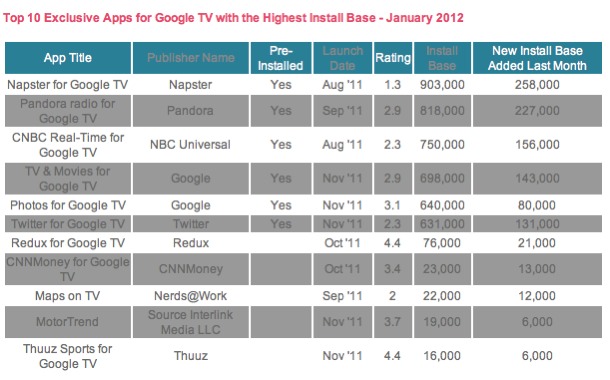
Research firm Xyologic released a bunch of statistics about Google TV today.  And those statistics point squarely at the amazing lack of app installs on the platform.  Granted, these aren’t official numbers from Google or anything, but they seem quite believable (except for the whole Napster as #1 app thing, which is just bizarre, but then again, so are apps on your TV).  Here’s the top 10 chart:

Source: RWW

So, people don’t want to download apps on their TVs eh?  I guess I’m going to go with the whole “I told you so” as my commentary (and I wrote that piece well over a year ago).

TV isn’t about apps.  It isn’t about technology.  It isn’t about “interacting.”  And most tech startups seem to want to make it a lot more about apps, technology and interaction.  Which is probably the leading indicator of why most TV-related ventures crash and burn – unfortunately too many of the folks involved are far removed from the typical TV audience.

I’d go so far as to say “TV isn’t about entertainment” when push comes to shove.  I think the best word to use to think about TV is “escape.”

There’s a reason channel surfing still beats out DVR usage, and why cord cutting is still not really a mainstream behavior.  Using your DVR or browsing content lineups is not about “escape”.  It’s about “work”.

The more the industry tries to get people to “work” for simple, enjoyable TV viewing, the more the industry will be littered with failures.  The same is true in the Smart TV space, the Social TV space, the Connected TV space, etc etc etc.  Keep in mind, as it is so very relevant, the concept of the paradox of choice: the more options and “power” you give a consumer, the more you will probably just be frustrating them.  It’s pretty hard to beat the experience of good ol’ TV today, period.

So if you are building a platform, an app, an experience, a gadget, a whatever to “improve” TV, think about the concept: “are you helping people escape?”  If not, it might be time for a “pivot.”

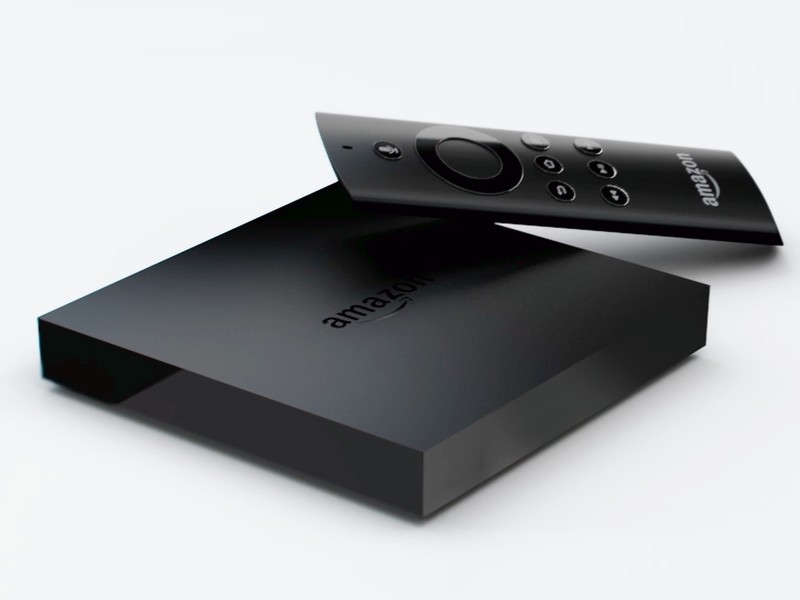
Is Amazon Building a Kindle Set-Top Box?

Friday, February 10th, 2012

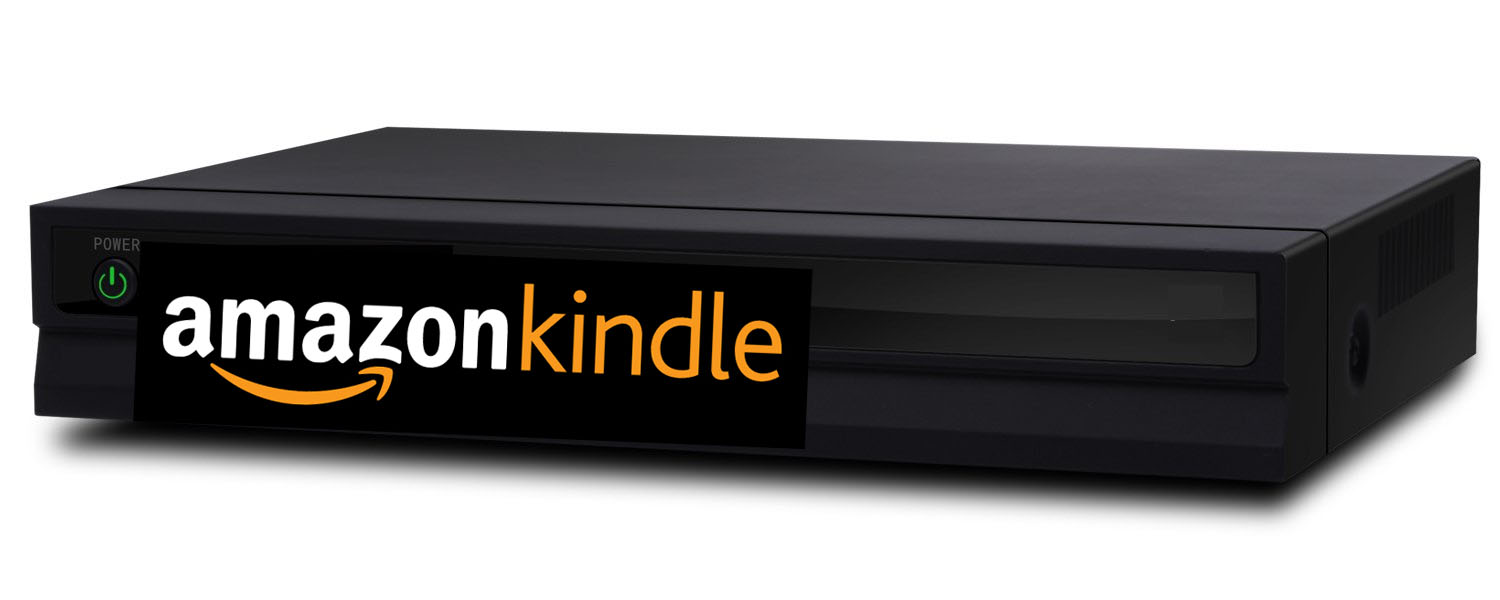
I'm awesome at photoshop! I hope it doesn't look like this!

I’m pretty sure the headline here says it all.  Let’s review the facts (it might be worth re-reading my bit on why HBO doesn’t go direct to consumers, as many of those issues are addressed here):

  1. Amazon has a large content library. They are actively increasing it.
  2. Amazon has a content distribution platform already capable of streaming to non-PC devices.
  3. Amazon has a recurring billing relationship with consumers.
  4. Amazon has a (phenomenal) marketing and distribution channel for getting devices into consumers houses.
  5. Amazon has a strong brand in the hardware space.
  6. Amazon has the customer service & support infrastructure needed to deal with service issues.
  7. Amazon has the ability to build hardware and deal with supply chain issues.
  8. The TV services industry is huge, and Amazon wants in.

Even if they don’t plan to decouple content from Amazon Prime, making a box is a very viable, and, in my opinion, a likely move.  In addition to all of the above, it is a strong move versus Apple (and possibly Google and Microsoft too).

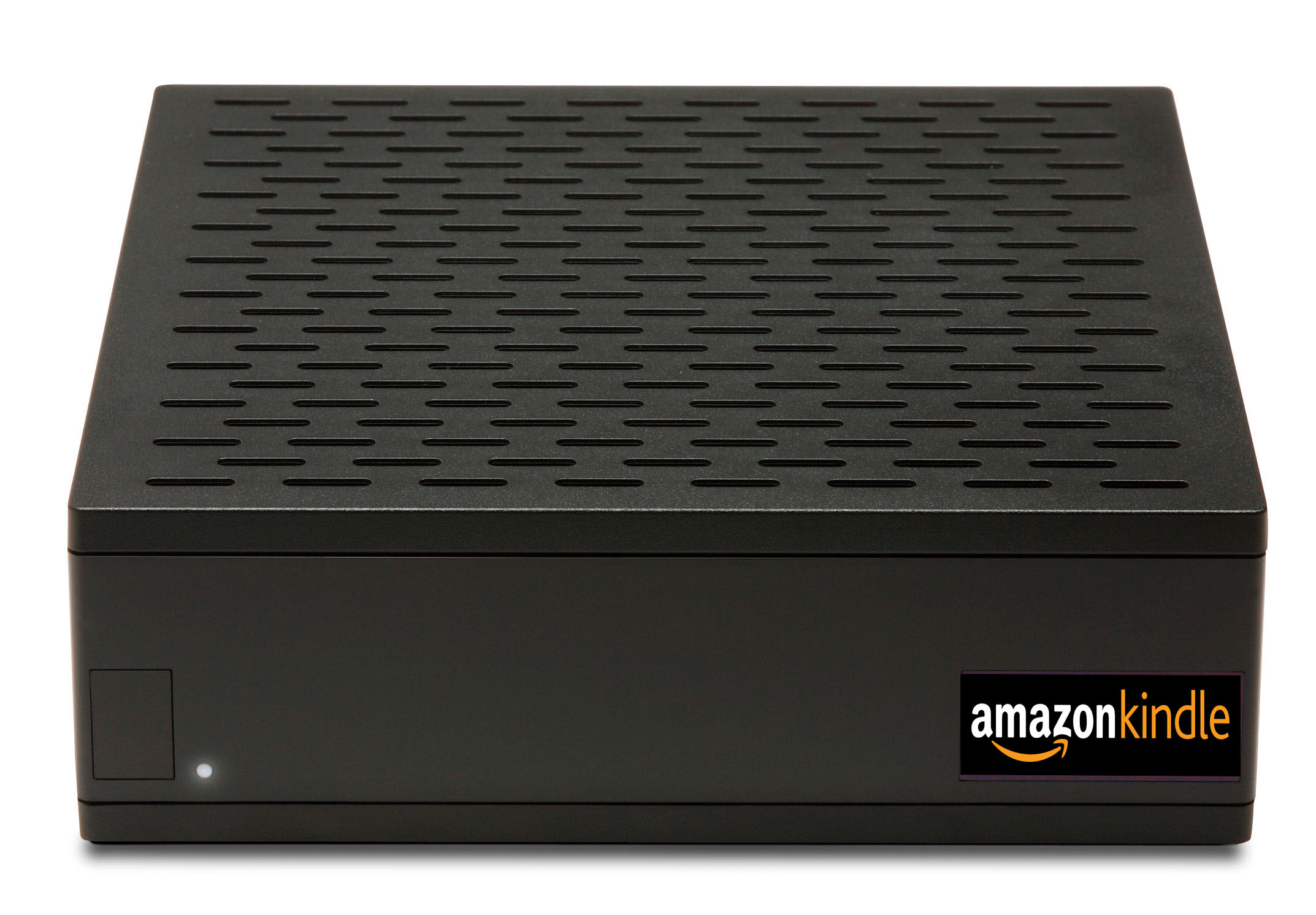
A $99 Amazon Kindle TV box would not surprise me this coming holiday season (how about a September launch, right in time for school?).  But then again, I occasionally get Kindle predictions wrong.

Kinda saw this one coming, didn't ya?

Oh, and one more thing.  What if they do it by acquiring Roku?  Let’s review that scenario:

  1. Roku already has something better than a minimum viable product.
  2. Amazon could skip all the work on developing a new UI/UX (regardless of your feelings on the Roku UX, it is well more than functional).
  3. Roku isn’t a sustainable business yet, enabling Amazon to purchase at a reasonable price.
  4. Roku has a team with a strong background and industry knowledge relevant to the TV/Device space.
  5. Amazon can distribute the same hardware at the same price point (which seems to fall in the not-too-profitably category), yet supplement with reliable recurring revenue.
  6. Amazon wouldn’t have to drop the Netflix service, but could slowly chip away at it from within.
  7. It’s cheaper than trying to buy Xbox from Microsoft (though that’d be quite the coup, plus nobody would even need to relocate)

I don’t really think Amazon *needs* to buy Roku, but it would probably let them fast-track a bunch of steps.  And then it could be a $49 Kindle TV, which just sounds so… right.

Why 2nd Screen Superbowl Ad and Social TV Experiences Suffered

Monday, February 6th, 2012

According to Lost Remote, social media was en fuego during the Super Bowl this year.  Bluefin Labs contributed to these stats, and found over 12 million “social media comments” during the game.  Another element Lost Remote tracked were the plurality of Social TV Second Screen Apps in play:

The best second-screen experience: To start things off, we checked into the game on GetGlueMiso,IntoNowShazamConnecTVUmamiFoursquare and Viggle. Ok, that’s overkill, but we wanted to give them a spin on the biggest social TV event of the year. For starters, GetGlue sailed passed its all-time check-in, counting over 100,000 before halftime and 150,000 total for the game, 3X its all-time record (the company doubled its servers for the Super Bowl.) We’re let you know of other second-screen stats when we get them.

Now that doesn’t include the “official” Super Bowl app, NBC Sports, or a few other options.  But overall, I’m see a glass is half empty scenario myself.

The problem was in the experiences.  I tweeted a couple of times during the game, by using the Twitter app, which was native and easy to do.  The thought of launching another app, just to get something that would enable be to tweet never even crossed my mind.  In reality, most of these apps actually got in the way of the experience.  And yes, while there was tons of tweeting and updates occurring, I’d lay down a strong bet most of this was about people posting, not reading what others were posting.

I also found the Super Bowl ads highlighted two major flaws in the ad experience.  Shazam got a lot of pre-game buzz for all their ad partners.  Sounds cool in theory, but the experience is just plain lousy.  First, the commerical starts airing.  Then, at some point in the middle of the ad a little Shazam logo appears somewhere on the screen (I only noticed it a handful of times personally).  At this moment, the viewer must grab their phone, turn it on, unlock it, switch to the Shazam app, and then – and this is important – get everyone in the room to be quiet for 7-10 seconds.  Great in theory, but this is not a good experience for any user.

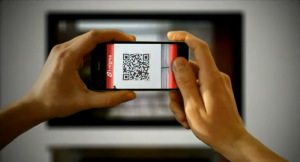
The second was a QR code which displayed on screen.  This in my eyes was even worse than Shazam, since QR codes require the user to have a QR app, which is just too obtuse for the average viewer.

worst. crossword. ever.

Compare either the Shazam or QR experience to having a simple URL onscreen.  Is it really easier to go through all the hassle and end up on the Honda website, or just tell the user to go to honda.com?  Plus, by obfuscating the simple methods, advertisers lose brand reinforcement AND are busy handing over the experience to a third party.  Similarly, when it comes to social experiences, is it to a consumers’ advantage to launch an app just to get an update into Twitter or Facebook, or to just use the native ones?

These experiences have come a long way, and are offering exciting potential for the future of TV and second screens.  But so far, we’re clearly at the infancy of what the consumer can use to really “enhance” a TV offering.  I hope some or many of these offerings will improve over the years, and really create a better experience, not one that makes us work harder just to watch TV.

Why Smart TV User Interfaces Suck

Friday, February 3rd, 2012

Please don’t look at the following images on a full stomach:


Ok, sorry I had to do that, but it’s important.  And to my friends on the TV manufacturing side of the world – it’s not your fault!  It’s not your fault! Most “Smart TV” user interfaces, suck, and you’re doing your best.  But fundamentally they violate so many rules of user experience design. But why are they so bad?  In a nutshell, its for the same reason you don’t expect loggers to sell fancy high-end furniture (think about that one for a second).  The products are being built from the wrong end of the production team.

For the dining room table, what do you think, arrow foot or ball foot?

Let’s agree that user experience design is a challenge to begin with.  Apple does it great, everyone else, not so much – and even Apple products have flaws.  Further, virtually everything about a “ten foot” user interface (the terminology we use to describe what happens on-screen on your TV) is a broken interaction model, so this is going to be crippled no matter what.  I’ll write about this more in the future, but I believe there’s a fundamental breakdown on the limitations of what you can do with any 10′ UI and a remote control, regardless of gestures, speech, etc.

Next, per my logger analogy, effectively the teams building these products have absolutely no experience nor expertise at this kind of design.  The world of consumer electronics has (barely) evolved from dials, knobs, and switches to doing highly complicated interfaces on screens.  Not only that, every year the requirements are changing!

And since this is a new field (despite almost 20 years worth of ten-foot UIs), there are very very few folks out there who have dived deeply into this problem (the Wikipedia page on the topic barely even requires a scrollbar to read everything).  So the same people who are used to just getting the TV to work right, are now also in charge of creating “an experience”.  I think this is a guaranteed to fail situation, and it’s unfortunate for everyone involved.

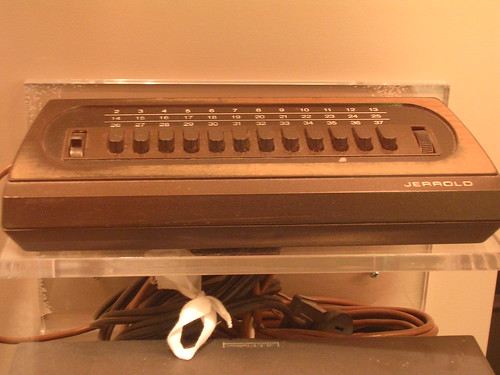
The last "easy" TV user interface.

I do have some tips and thoughts for these UIs, since I can’t effectively get everyone to just up and stop making them (pretty please?).  First, you can read my comments a while back on designing better Boxee and Google TV apps.  Now, here’s three more things to think about:

  • Stop making things look like Commodore 64 graphics.  Seriously, I understand the graphics processors inside the TV platforms are low powered inexpensive solutions, but people have a natural (bad) reaction to seeing such low quality graphics on their beautiful HD sets.  If you can’t match them up, find ways to cut down on the overall interface and use the scarce resources to make things prettier.  See Boxee, Google TV, and Apple TV for the “prettier” 10-foot experiences.

Now in beautiful Full 1080p HD

  • Understand a 2D “grid” of options.  Many of these UIs create multiple planes of interfaces, yet fail to recognize the user has to navigate with a simple UDLR remote control (or wand or whatever).  This creates unpredictable experiences, and makes your user less naturally comfortable with the interface.  You should be able to look at the screen and always know “what happens if I push the Up arrow button”.
  • Reduce button clicks.  At no point should the user have to click more than 3 times to get from one part of the screen to another, and you should never create an internal scrollable region.  For example, my VUDU service (which I love) has me scroll through long lists of movies when browsing a category (such as Comedy/Drama, which, let’s face it, really means depressing movie with some funny moments).  But, as a result, if I want to change the category,I need to scroll all the way up to the top of the screen again to choose a new option.  This is too much work!

Ultimately, this again reinforces my belief that anything new coming from Apple will be highly based on AirPlay concepts, and the 10-foot UI will one day be a thing of the past.  And what will replace it?  This.

Why iMacs will get Apple TV, not Apple Television

Wednesday, December 7th, 2011

Ah, Apple punditry, rumors, and speculation.  And back into TV land we go.  Today from Forbes:

Wedge Partners analyst Brian Blair this morning asserted in a research note that that the next version of the iMac, likely in the 2012 first half, will include some new TV functionality – basically, turning the desktop Mac into a bridge to a full-fledged television business.

This, plus another analyst who seems to know the exact sizes of the new long-awaited Apple Televisions is certainly fun reading.  But what parts make sense?

iMac + Apple TV?
Yep, makes sense.  After all, we’ve had Front Row in Macs for a long time now, it’s way overdue for an update, and having it function identically to Apple TV is a nice fit.  I’m buying this one.

iMac + Apple Television (aka iTelevision)?
To be a “television” a product, for the most part, includes a buit-in TV tuner.  It also has multiple inputs, and has all sorts of requirements/parameters for video display.  These components are effectively inconsequential to add, cost-wise to an iMac, so from a pure “could they build it feasibly” perspective, this actually passes a sniff test.

However,  what is this new product?  Is it a big computer “Now, from Apple, a 46″ iMac that you put in your living room”?  Is it a small TV “Now, from Apple, a 27″ iTelevision that fits nicely on your desk”?  Is it all of the above “Now, from Apple, in 7 different sizes, with 11 configurable options, the iMacTV.  We cook it your way”?

You know what it is?  Frankenstein.  Confusing.  To throw in some industry jargon – it’s what we’d call a “hodge-podge”.  Hard to explain.   How many other products that Apple ships are described like this?  None.  It’s the antithesis of an Apple product.  It’s something a PC company might do, certainly, but not Apple.

I still believe that iTelevision is coming.  I think we’ll, at the very least, learn a lot about it in 2012.  But there’s no weird “mashup” device coming.

They don’t ship iHodgePodge, not at 27″, 32″, or 55″.

Netflix + Arrested Development? Come On!

Monday, December 5th, 2011

I was asked by well-respected analyst firm TDG to pen a piece of the impact of Netflix wrapping up exclusive rights to the upcoming 4th season of Arrested Development (for their must-read OTT Newsletter).  At first they asked if I could get it done in the next two weeks, but I said, “two weeks, I can do it in two days. Hey!”  So readers who are surprised at that phrasing will probably want to stop right about now, since the rest of it is, in fact, an analysis, but one heavily wrapped in Arrested Development quotes.  You’ve been warned:

“I’ve made a huge mistake,” a quote that could either be attributed to the hasty creation (and destruction) of Qwikster, or to one G.O.B. Bluth, Will Arnett’s character on Arrested Development. In a groundbreaking move, those worlds collided as Netflix announced it was the “network of choice” to distribute the upcoming revival of the cult favorite show (leading many of us to say, “them?”).

Not FOX (the original broadcaster of the show), not Showtime (once rumored to pick it up from FOX), was in play here. In fact, not a single broadcast, cable, or premium network will carry the new episodes.

While Netflix already has rights to a forthcoming original effort (House of Cards, by David Fincher and Kevin Spacey), the Arrested Development play is a first for an existing show to be revived yet not be available through traditional TV (as fans of the show might say, “no touching!”).

Part of the curiosity here is that the show now has a larger fan base than when it was cancelled in 2006, and populates many “Most Popular” lists on Hulu, Netflix, VUDU, etc. One would assume traditional broadcasters would express interest in locking down that large audience…so much for assumptions.

For Netflix in particular, this is a very big deal. The company is acting like a loose seal out of water and consequently has Wall Street running scared. Having exclusive access to this show might bring back some of the recently lost customer base and could sit well with show fans, especially given that a key criticism of its service is related to its catalog.

From an OTT perspective, it’s safe to say there is no illusion of the tremendous opportunity ahead. In a world that seems to be moving more and more down a path where consumers can get truly quantum video access – the content they want, from the provider they want, on the device they want, at the time they want – this is a big stride forward.

Disclosures: I own a tiny amount of Netflix stock personally, but much more importantly, I’m a huge huge Arrested Development fan.  And as they say, there’s always money in the banana stand.  Come on!

ps – and that’s why you always add a disclosure.

List of SmartTV Events for Fall 2011

Thursday, September 8th, 2011

Budapest Parliament Hall. This would be an awesome place for a smart TV conference!

Just like my Future of TV Newsletter (thanks to all the subscribers – wow!), I thought it would be helpful for all my peers to create a list of all the events I’m tracking this Fall that have anything to do with Smart, Social, or Connected TV.  That said, I’m sure I’m missing some (please email, tweet, or comment if you know of any!).  The list below also includes some of the speakers that are presenting, though is incomplete (I only had so much room on the page, sorry to anyone I cut – it wasn’t personal.  Well, mostly.).

The Future of #SocialTV – Sept 14 – New York City

Speakers include:

  • Brian Stelter, TV & Digital Media Reporter at The New York Times ( @BrianStelter)
  • Mark Ghuneim, CEO of Wiredset/Trendrr, @MarkGhuneim
  • Valerie Streit, Strategist at YouTube/NextNew, @ValStreit
  • Ryan Osborn, Director of Social Media at NBC News, @Rozzy
  • Alex Iskold, Founder & CEO of Get Glue, @AlexIskold

Lean Back – Sept 14 – San Francisco

Demos by:

Digital Home Summit – Sept 27/28 – Orlando

Speakers include:

2Screen – Sept 29 – London

Speakers include:

TV Next 2011 – Oct 4-5 – San Jose

Speakers include:

  • Sherry Brennan, FOX Networks
  • Steven Reynolds, Comcast
  • Eric Bruno, Verizon
  • Jim Louderback, Revision3
  • Larry Robinson, Motorola Mobility
  • David Mcintosh, Redux
  • Jeremy Toeman, Dijit
  • Kurt Hoppe, LG Electronics
  • Colin Dixon, The Diffusion Group
  • Stephen White, Gracenote
  • Richard Bullwinkle, Rovi
  • Ryan Massie, CBS Interactive

The Connected TV Experience – Oct 11/12 – Chiswick/London

Speakers include:

  • Anna Bateson, marketing director, EMEA at YouTube;
  • Lesley MacKenzie, group digital officer, at LOVEFiLM;
  • Anthony Rose, co-founder and CTO of Zeebox;
  • Dan Saunders, head of content services at Samsung;
  • Bjarne Thelin, chief executive, BARB;
  • Nigel Walley, managing director of Decipher;
  • Tom Wolfe, senior director, advanced advertising at Rovi.

Digital Hollywood Fall & the Variety Entertainment & Technology Summit – Oct 17-20 – Los Angeles

Speakers include:

  • Quincy Jones (yes, Quincy Jones!)
  • Harshul Sanghi, Motorola Mobility Ventures
  • Kerry Trainor, AOL
  • Jeremy Toeman, Dijit
  • Dan Cohen, Disney-ABC Domestic Television
  • Stephan Shelanski, Starz Entertainment
  • Leslie Wood, The Nielsen Company
  • Gregg Spiridellis, JibJab Media
  • Bill Gannon, Entertainment Weekly
  • John Griffin, Dolby Laboratories
  • Curt Marvis, Lionsgate
  • Lance Koenders, Intel Corporation
  • Kurt Hoppe, LG Electronics

Smart TV Europe – Nov 1/2 – London

Speakers include:

  • Karla Gecki, Facebook
  • Dan Saunders, Samsung
  • Stacey Seltzer, LG Electronics
  • Jordy Egging, Philips
  • Eric Elia, Brightcove
  • John Denton, BBC
  • Yosi Glick, Jinni
  • Anthony Rose, tBone TV

Streaming Media West 2011 – Nov 8/9 – Los Angeles

Speakers include:

  • Chris Knowlton, Microsoft
  • Michael Aragon, Sony Network Entertainment
  • Fred Santarpia, VEVO
  • John Civiletto, Cox Communications
  • Donagh O’Malley, Google TV
  • Paul Wehrley, Clicker.com
  • Ran Harnevo, AOL Video
  • Rob Roskin, MTV Networks
  • Gilles BianRosa, Fanhattan
  • Andrew Wallerstein, Variety
  • Greg Sandoval, CNET
  • Jim Funk, Roku
  • Evan Young, TiVo
  • Derrick, Oien, Chumby

TV of Tomorrow NYC Intensive 2011 – Dec 5 – New York City

Speaker list not yet finalized

Digital Living Room – Dec 7/8 – San Francisco

Speakers include:

  • Ashish Arora, GM, Digital Home, Logitech International
  • Ian Geller, VP, Business Development, Pandora
  • Joe Greenstein, Co-Founder and CEO, Flixster
  • Neal Hansch, Partner, Rustic Canyon Venture Partners
  • Evan Krauss, EVP, Advertising, Shazam Entertainment
  • Scott Levine, VP and Managing Director, Time Warner Investments
  • David Schlacht, Sr. Director, Multimedia, DirecTV
  • Jeremy Toeman, Chief Product Officer, Dijit
  • Charles Seiber, VP, Marketing, Roku
  • Paul Wehrley, General Manager, Clicker.com and TV.com, CBS Interactive