Archive for February, 2011

My Analysis of Google TV’s Ten Foot UI in Nikkei Electronics

Tuesday, February 22nd, 2011

I recently had the opportunity to critique the Logitech Revue’s ten foot UI for Nikkei Electronics, a Japanese trade magazine that “offers prompt reports, to-the-point commentaries and in-depth analysis on advanced technologies.”

Phil Keys, US Correspondent for NE, approached me for this project. He wanted an expert opinion on how to build a better interactive user experience for the home theater. I have known Phil since my days at Sling and Mediabolic and working with him was a real honor and privilege.

I applied user-centric design principles to grade the Logitech Revue and point out its strengths and weaknesses. My review was then translated and printed up, along with photos of the Logitech UI. Here is a small sample of the article.

Thanks to Nikkei Electronics for the opportunity to deliver Smart TV best practices to a global audience.

An Analysis of Amazon’s Free, Unlimited Streaming Video Service

Tuesday, February 22nd, 2011

Starting today, Amazon Prime customers can take advantage of the company’s new, unlimited video streaming service. Amazon Prime Instant Video is free, with a few caveats. Quoting from Engadget:

This is only for paid Prime subscribers, so if you’re a college student or the like with a free membership you’re sadly out of luck. Also it’s US only at this point.

Of course, comparisons to Netflix are inevitable here. Early reports say that Amazon’s catalog of titles is comparable to Netflix, while the quality of Prime’s video has been so-so. Prime Instant Video will have some ground to make up if it wants to compete toe-to-toe with the market leader.

Amazon streaming is missing from a few key set-top boxes, including video game consoles and TiVo.

There are 180 million current generation video game consoles on the market, and they all offer Netflix. So that means that Netflix is in more components, has a larger content library and offers higher quality video.

Which is not to say that Amazon is DOA. Not by a long shot.

It would be interesting to know what the goal of Prime Instant Video is. Do Bezos and company want more people to pay for Prime shipping, or is this offer aimed at getting people used to watching videos on Amazon and – later – purchasing media from their ecosystem?

Amazon can assemble a formidable library of content. They don’t need the same titles as Netflix, but the shows and movies need to be compelling. To win here they need to offer a blend of new releases and older classics (think TNT shows and the kind of programming you chill out with on a Sunday afternoon). Expect the library to mature as the service does.

Amazon could also white label Prime Instant Video and let other content providers offer their videos over the Prime streaming media center. The troubled Blockbuster brand could find new life here as a streaming only service (although at this point we’re not even sure if Blockbuster knows what streaming video is).

Finally, Amazon needs to get on as many pieces of hardware as they can. If people can only use Prime Instant Video on their desktop, it will have limited value. One of the first goals needs to be getting on gaming consoles, mobile devices and televisions. Again, this is an attainable goal, especially for Amazon.

I have always maintained that there can be more than one “winner” in the streaming media wars and there is certainly room for Amazon’s service to grow alongside Netflix. While the two services will probably compete for some customers, one does not have to lose for the other to win. It is clear, though, that the stakes of the online distribution game have just been raised.

Yet Another Cord Cutting Stumble

Tuesday, February 15th, 2011

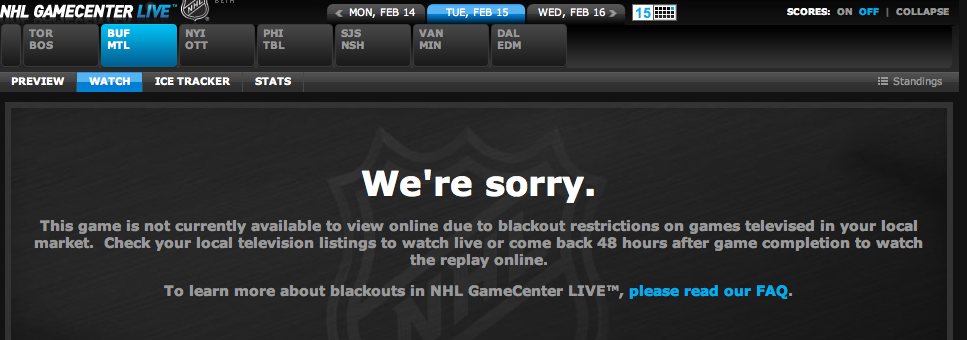
For the third straight season, I signed up for NHL GameCenter to watch Montreal Canadiens games and so far the experience is a good one ($160 for 82 games is a pretty great deal, although offering 40% off a season that is 60% over is certainly questionable). I also have the sports channel Versus through my cable subscription, and they broadcast around 8 Habs games per season, which should mean more hockey for me (yay!).

But unfortunately, that isn’t what winds up happening. In fact, I get less hockey. Because Versus has the rights to air certain Habs games in my local area, they are blocked out on NHL GameCenter for two days (see above, infuriating pic). What that means, then, is that if I forget to DVR the Versus game at my home, the footage is unavailable to me for 48 hours, even though I have paid to watch the game on two distinct platforms. And I don’t always remember to set a recording, given state of the art hockey schedule on the Versus site (so easy to read!). There is nowhere to go on Versus or on NHL GameCenter to watch the game while it is blacked out. This makes no sense. I can sort of understand blacking out the NHL GameCenter footage during live play (sort of), but once the game is over, the online version should be available to everyone who paid into it. In my opinion, the best way to grow the sport is to show more hockey, not less.

These media blackouts need to go the way of rabbit ear antennas. In an era of streaming online content, DVRs and smart, mobile media players, locking paying customers out of content for any length of time is silly. Someone needs to figure out a way to deliver out of market games in a timely manner so that “blackouts” become a thing of the past. These antiquated media restrictions show that cord cutting is far from a reality at this time. This is an issue facing technology and media companies, as well as the sports world.

Blackout rules were a bad idea when they were first conceived in an effort to make people go to the stadium and they are even more ludicrous now.

The Internet Needs More Humans In Charge

Thursday, February 3rd, 2011

I keep running into a problem with Gmail. Every so often – without warning or good cause – it rejects one of my emails as undeliverable spam.

These aren’t mass email blasts or creepy solicitations. These are emails addressed to my coworkers and colleagues getting bounced back for no discernible reason.

From: Mail Delivery Subsystem <mailer-daemon@googlemail.com>

Date: December 2, 2010 3:16:09 PM PST

Subject: Delivery Status Notification (Failure)

Delivery to the following recipient failed permanently:

Ugh. There are two main problems here. The first is that an email between two people who work together and know one another in real life is getting marked as undeliverable spam. This should be a “solved problem”, but apparently it isn’t. Bummer.

The second, far worse, problem is that I have no (reasonable) way to correct to this error message. There is no one to contact in person. Literally not one customer service professional at Google to call and fix this situation. The only recourse I have is a help forum. Which is ridiculous.

Sure, I could pay Google $50 per year and get phone support, but this seems outrageous. And I am not the only person who feels this way. Quoting from Krish Subramanian’s excellent post on this same topic:

I fully understand that Google cannot offer support for free users. However, there should be some other option for me to get in touch with Google (say, an email support for an one time fee of $10). It is important to recognize that Google Apps Standard Edition users not only help Google monetize through Google Ads, they also serve as a “testbed at scale” for Google so that they can serve their paid customers better. Also, many free users eventually become paid users too. In short, these free users are not freeloaders and Google should offer some way to escalate those issues that are not getting solved in the forums.

That last point is especially salient. I support Google in other ways. I search, I click ads, and I use and evangelize their apps. They should be invested in my well being and satisfaction.

But this issue is larger than Gmail’s nonexistent customer service. The bigger picture is a lack of humans in charge on the internet. In order to flourish, the internet can’t be all bots and algorithms. There needs to be a personal touch influencing (or at least checking) high level decisions.

Now, humans can’t run the entire web, but certainly we can do better than this scenario recently published on the RAAK blog. This social media firm set up a few Twitter bots in order to see how klout measured their influence.

The four bots Tweet[ed funny non sequiturs] once every minute, once every five minutes, once every fifteen minutes and once every thirty minutes respectively. They are completely anonymous, have no avatars or custom user profiles set, and do not follow anyone.

The results weren’t pretty. Here are the klout scores for the once a minute bot.

It should not really be possible for a bot to reach a Klout Score of 50 within 80 days merely by Tweeting random (yet entertaining) rubbish every minute, should it?

No, it shouldn’t. And even though the CEO of klout jumped in to the comments to participate in this discussion, the real issue here is a lack of humanity making key decisions online.

I would look back at Rand Fishkin’s post which we wrote up last month:

Why does a page rank first in Google for a particular query? Why does one link stay on Reddit’s homepage for hours while another, with a similar number of votes, fall off in just a few minutes? Why does Facebook show me ads for customer service jobs at Comcast? Why did Amazon recommend buying whole milk with this Badonkadonk Land Cruiser?

If we don’t understand why these suggestions were made, couldn’t that bias us against trusting future recommendations from these services?

As a closing example of the frustrating state of the machine-run internet, Google once marked my personal blog as Spam. And there was literally nothing I could do about it other than fill in some form and hope (I also tried doing the blinky-thing like in I Dream of Jeannie, not sure which was more effective). Not one person to call. No one to follow up with face to face. A machine blindly made a (wrong) decision and I couldn’t contact a human being to talk about why this happened and how we could prevent it from happening in the future. For all the talk about “connecting people,” the internet – as it is set up today – actually does a poor job of allowing humans to interact with one another when they need to most. When things break or don’t turn out as expected.

This isn’t just an problem with Google. It’s Facebook. It’s Yelp. The system we have all agreed to online is callous, demoralizing and broken. And it’s getting worse.  Yes there are help forums and FAQ sections and Customer Service email addresses on Help Pages. But what I am arguing for here- and what the internet should be – is a network that unifies and empowers people. A place where all are welcomed and made to feel welcome by people who care about getting things right all of the time. And for that to happen, the way things work online will take a more human touch.

In other words, make the Internet more like Soylent Green.